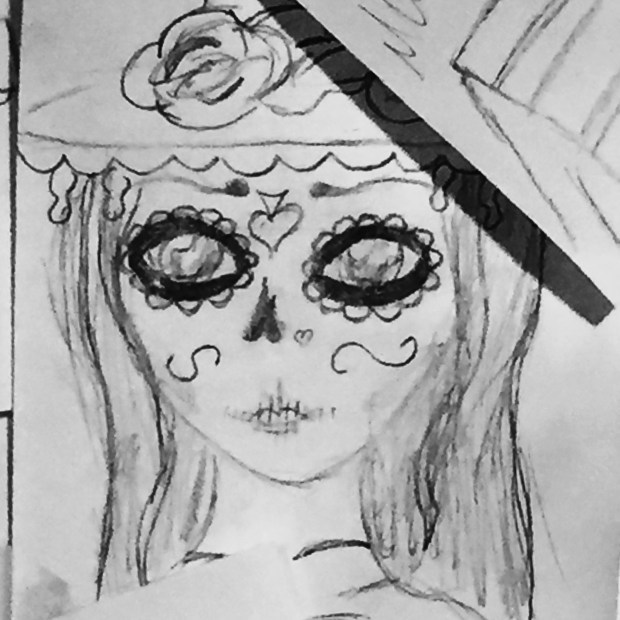
Viva la Vida: Mexic-Arte Museum honors Día de los Muertos festival for 32 years in Tejas

nicolette mallow

La Catrina drawn by unknown artist at The Mexic-Arte Museum. Photography by Nicolette Mallow.

Since the doors first opened in 1984, the Mexic-Arte Museum in Austin has celebrated thirty-two years of Día de los Muertos (Day of the Dead) festivities. This October the museum presents two seasonal exhibitions alongside its annual Viva la Vida festival featuring a grand procession, artist vendors, live music, and a grand sugar skull piñata float by local piñata artisans Monica and Sergio Lejarazu. The museum will also host a black-tie masquerade event known as the Catrina Ball that will debut at The Four Seasons Hotel.

The highlighted Día de los Muertos exhibition at the Mexic-Arte Museum, Community Altars: Ofrendas Inspired from the States of Mexico, is located within the main gallery and contains nearly a dozen altars to honor the lives of loved ones who are deceased. Adorning the altars are flowers, crosses, candles, angels, framed photographs, flags, hand-cut paper, skulls and catrinas. Echoes of a film directed by Jim Hill, Llamar a los Muertos a Casa (Calling Home The Dead), are heard as guests walk about the rooms. In the very back of the exhibition there is a bench to sit and watch the movie about the villagers of Lake Pátzcuaro. And viewers can learn why it’s believed this land is a doorway to heaven.
nicolette mallow

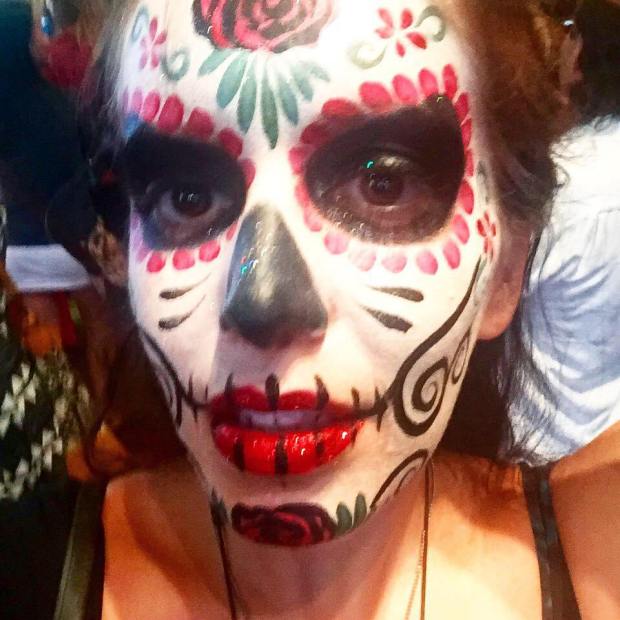
Nicolette Mallow in La Catrina face paint at the Viva la Vida festival in October 2015.

Each altar represents the regional and cultural differences within diverse areas of Mexico, including the following states: Guanajuato, Guerrero, Jalisco, Michoacán, Oaxaca, Puebla, San Luis Potosí, Veracruz, Mexico D.F. and Coahuila. Admiring the similarities and dissimilarities between the altars is part of the appeal. Not a single altar is identical to another, and yet the holiday spirit Día de los Muertos is strong within every altar, unifying the exhibition at the Mexic-Arte museum.

In 2003, the 78th Legislature of the State of Texas awarded the Mexic-Arte Museum as the Official Mexican and Mexican American Art Museum of Texas. Also according to their website, “Día de los Muertos is an ancient, Mexican and Mexican American religious holiday with a historically rich tradition that integrates both pre-Columbian and Catholic customs. It is often celebrated in connection with the Catholic Holy Days of All Saints’ Day and All Souls’ Day (dates and length of the celebration vary by state or region). In the celebrants’ minds, the holiday is a time to honor and greet their deceased relatives and friends, who make the journey back from Mictlan (the underworld in Aztec culture) to be with the living each year. These days are a time for families and friends to gather in celebration of life and death, embracing the circle of life rather than loss and sorrow.

Standing in a room of altars that pay homage and respect to the dead, it might not seem like a place of love and light to those unfamiliar with Día de los Muertos. However, there is an undeniable force of love and life flowing throughout the rooms. An intense and evocative kind of love that can be seen and felt like standing next to a bonfire on a frigid moonless night. Looking at the altars one-by-one, imagining the time it took to make it all by hand. Thinking about the fact that massive quantities of people from all over the country designate the time and energy each year to create memorials. Memorials that signify and represent their memories towards family members or loved ones no longer living is indicative of their selflessness, loyalty and respect. It’s indicative of their devout love. It’s very moving to the heart and mind as guests walk from altar-to-altar; absorbing a sense of each person, or persons, revered at every altar by those still living. Unlike a tombstone that only states a name and dates of life, these large altars are unique to each family member and give viewers are stronger sense of personality. Books, jewelry, baskets of black beans, blankets, pottery, Marlboro cigarettes, bottles of tequila, and guitars; various items are placed throughout the altars, humanizing and personalizing the interests and pleasures of each person’s life.

Additionally, bright lights and vivacious colors illuminate the altars. Color and light are key elements in this exhibition at the Mexic-Arte Museum. Blue, red, pink, yellow, green and violet are prominent colors seen throughout the altars in the main gallery. Marigold flowers are one particular item of deeper significance seen at every altar. “Marigolds guide the spirits to their altars using their vibrant colors and scent. It is believed that the spirits of the dead visit the living during the celebration. Marigolds, or flowers in general, also represent the fragility of life. The marigold most commonly used in Día de los Muertos celebrations is the Targetes erecta or African Marigold, otherwise known as cempasúchil or flower of the dead.”

To view the history of thirty-one prior Día de los Muertos celebrations at the Mexic-Arte Museum, please venture to the annex gallery. Exhibitions will be on display through most of the autumnal season until mid-November. Please note the Viva la Vida festival is a daylong, eight-hour event open to the public on October 31, 2015. Tickets to the Catrina Ball on October 17, 2015 can be purchased online. For more information regarding upcoming events, exhibitions, admission, memberships and hours of operation, please visit www.mexic-artemuseum.org or call 512-480-9373.

¡Viva Mexico & Tejas!

Note: This article was originally published on Examiner.com in October 2015. 
This slideshow requires JavaScript.

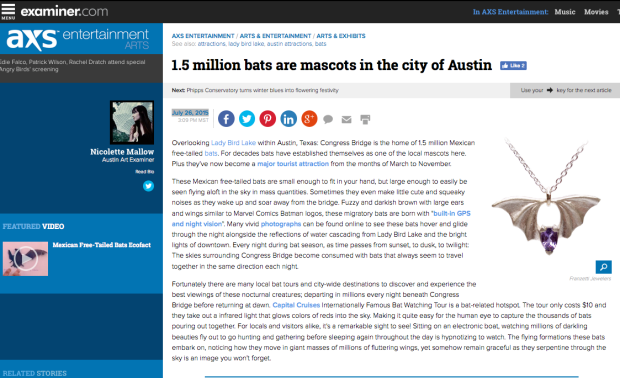
1.5 million Mexican free-tailed bats are mascots of the night in ATX

nicolette mallow

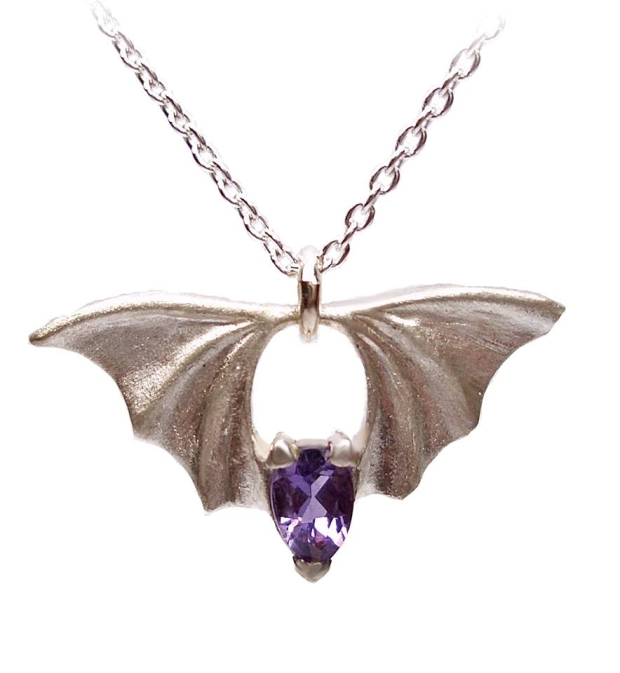
Amethyst Bridge Bat pendant by Franzetti Jewelers.

Overlooking Lady Bird Lake in Austin, TexasCongress Bridge is a home for 1.5 million Mexican free-tailed bats. For decades, bats have established themselves as one of the local and beloved mascots in ATX.  It was discovered in the 1980s that these Mexican free-tailed bats eat millions of pounds of insects a night, including agricultural pests, ultimately providing many benefits to the city, its residents, and the ecosystem.   Plus, our bats are terribly endearing to the eyes, and it’s kind of nice to know. These nocturnal creatures are embarking on hunting flights in masses to run their little errands of the night as a great deal of the city is sound asleep.   

The ATX bats have now become a major tourist attraction from the months of March to November. People wait at sunset for the bats to wake up and leave the bridge. They fly in the sky from dusk to dawn! From afar, they are safe and harmless, with no interest in humans. But do not touch or handle one, and certainly do not trap or hunt them. The bats are only to be admired and adored from a safe distance by land or water. For the best views, people can stand on Congress Bridge, under the bridge, or take an electric boat tour. Visitors may want to bring a red light past dusk to see the millions of bats exiting the bridge a lot clearer in the dark. 

Mexican free-tailed bats are small enough to fit in your hand but large enough to be easily detected by their shape. These bats move differently than other local airborne critters, and sometimes, they look like they are flying in circles. The bats fly similarly to big butterflies, and yet their wingspan looks nothing alike, and they are less graceful. So pay attention to their wings and shape to know when you’re in the presence of a bat versus a frantic bird! When they are leaving Congress Bridge by the millions, these bats aren’t always quiet or stealthy.  Sometimes, they make a lot of cute and squeaky noises as they wake up and soar away. Fuzzy and soft with fur that is various shades of brown and gray, large ears for its size, and a wingspan similar to Marvel Comics Batman logosthese migratory bats are born with “built-in GPS and night vision”.

The bats at Congress Bridge make for capturing fantastic photos! Reflections of water cascading from Lady Bird Lake and the bright lights of downtownmany vivid photographs can be found online to see these bats hover, play and glide through the night sky in Austin. Every night during bat season, as time passes from sunset, to dusk, to twilight: people gather around Lady Bird Lake to see the atmosphere become consumed with gusts of bats pouring out of Congress Bridge. Departing in millions after sunset beneath Congress Bridge before the bats return back around dawn. Some people like to hang out on the bridge, but a boat is another fun option.

Fortunately there are many local boat tours and city-wide destinations to discover and experience the best viewings of these beauties. Capital Cruises Internationally Famous Bat Watching Tour is a good choice and I have attended once, even thought I am a local Austinite of 20+ years. The tour only cost $10 and they take out a infrared light that glows colors of reds into the sky. Making it quite easy for the human eye to capture the live visuals of millions of bats pouring out together in droves. For locals and visitors alike, it’s a remarkable sight to see! Sitting on an electronic boat, watching the bats can be rather hypnotizing and exhilarating to watch. As if the bats are putting on a show for us all, without any of the cruelty of a standard zoo or a traveling animal circus. However I do recommend choosing the covered boat as these bats are just waking from a deep sleep.

According to Bat Conservation International, “When engineers reconstructed the Congress Avenue Bridge in 1980 they had no idea that new crevices beneath the bridge would make an ideal bat roost. Although bats had lived there for years, it was headline news when they suddenly began moving in by the thousands. Reacting in fear and ignorance, many people petitioned to have the bat colony eradicated. About that time, Merlin Tuttle brought BCI to Austin and told the city the surprising truth: that bats are gentle and incredibly sophisticated animals; that bat-watchers have nothing to fear if they don’t try to handle bats; and that on the nightly flights out from under the bridge, the Austin bats eat from 10,000 to 20,000 pounds of insects, including agricultural pests. As the city came to appreciate its bats, the population under the Congress Avenue Bridge grew to be the largest urban bat colony in North America. With up to 1.5 million bats spiraling into the summer skies, Austin now has one of the most unusual and fascinating tourist attractions anywhere.”

In 2007, the city of Austin changed the name of the reservoir running beneath Ann W. Richards Congress Bridge from Town Lake to Lady Bird Lake. The name change was a controversy in-and-of itself as the Former First Lady of the United States, nicknamed Lady Bird Johnson, was against the idea of naming this lake after her and wished for it to remain as is. However, when she passed away the city opted to change the reservoirs name in honor of all the hard work, dedication and endless support that Claudia Alta Taylor “Lady Bird” Johnson bestowed upon the state of Texas. Particularly her involvement with the Town Lake Beautification Project in Austin: the state capital of The Lone Star State.

Thankfully these special and unique Mexican bats living on Lady Bird Lake beneath Congress Bridge are forever protected by the city, solely because of individuals like Lady Bird Johnson and Merlin Tuttle. However, Austin’s love for bats exceeds far beyond Congress Bridge. Bat-related art and merchandise can be found all over the city at many local gift shops. Franzetti Jewelers is a perfect example of a local company that has taken a mascot of the city and turned it into beautiful jewelry. Designing necklaces, rings and pendants; Franzetti Jewelers offers silver and gold, bat-inspired jewelry with stones of garnet, blue topaz, citrine, peridot, onyx, amethyst, smoky quartz and white quartz.

For more information regarding the Mexican free-tail bats of Austin and the best times to find them this summer and fall under Congress Bridge, please consult www.batcon.org.

Note: This article was originally published on Examiner.com in July 2015.

Screen Shot 2016-07-07 at 3.30.54 PM

Art by Eya: Dreamscape artist and local Texan beautifies the city of Austin

Nicolette Mallow

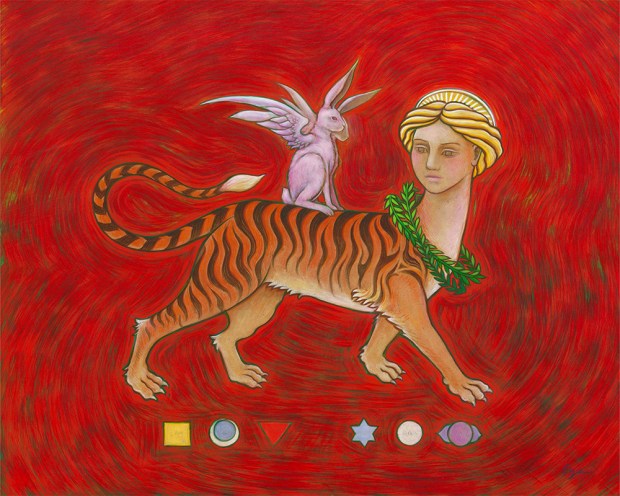
“Tiger Lady” by Eya Floyd.

Born and raised in Austin, TexasEya Claire Floyd is an artist and local Texan whose work is found at many local artisans fairs and retail boutiques around town. Creating whimsical,  introspective and playful pieces that illuminate the room with their vibrant colors. There is something magical about Eya’s work, too. Intertwining nature, animals and people in a mystical way that could only happen in our dreamssuch as a bird with a woman’s head or a fierce tiger with giant wings like an Egyptian deity it seems as if her characters are shape shifting at times. Transforming into creatures that appear in fantasies or myths and not reality. Many of the characters within Floyd’s art pieces also seem to be floating in time and space – adding to the allure of the dreamscape theme.

This slideshow requires JavaScript.

Floyd’s ability to integrate a plethora of fanciful creatures, nature and scenery into her pieces is endless, just like her imagination. Would you like dinosaurs digging in the sand? She’s got it. A monkey riding the back of a dragon? She’s got that, too. Or maybe you need a bird girl carrying a red heart in her claws. There is something for everybody’s taste.

The paintings and illustrations she designs are so beautifully simplistic and yet so intricately detailed – it leaves the eyes with an equal sense of peace and excitement. Another positive trait about her art is that it’s beloved by audiences of all ages: children and adults. A lot of her artwork is reminiscent of childhood with its light-hearted spirit, and yet other pieces are adult-oriented. The universal aesthetics withn her work evokes endearing emotions of love, humor and happiness whilst admiring Eya’s artwork.

Nicolette Mallow: Can you tell me a bit about your involvement with the Austin art scene and the local community?

Eya Floyd: My first exhibition as an adult was in the 1990’s and since then I have been creating and showcasing my art, mostly paintings. I find painting to be the most challenging and I think that’s why I like it so much. But I also like to create ceramic sculptures. Regardless, last year I assisted the group SprATX in an outdoor mural at the HOPE Outdoor Gallery. The mural was then featured in a full-spread on the inside, back cover of a book, “Hope Outdoor Gallery: Lost and Found Volume I”. Recently I also became involved with Little Artist Big Artist and that has been very rewarding to me, too.

NM: Your booth displays at art fairs always showcase a ton of items to purchase far beyond paintings. What are your best-selling pieces?

EF: Yes, in addition to a mass amounts of prints and paintings in various sizes that I do sell. A lot of my art I’ve turned into various forms of merchandise: pendants for necklaces, coin purses, bags, matchboxes, magnets, postcards and temporary tattoos. My best sellers are certainly my necklaces, the temporary tattoos and the miniature prints that I’ve framed. People love miniature art.

NM: You are well known and appreciated by the locals for participating in so many artisan fairs and art shows around town. Will you be partaking in any upcoming art-related events?

EF: Yes. On August 8, 2015 I will be at the Austin Flea, hosted by The Highball adjacent to Alamo Drafthouse on South Lamar. And on August 16th, next month I will have a booth set-up at East Side Pop Up, a traveling art showcase that primarily supports local artists in Austin.

For more information regarding Eya Floyd’s artwork, please refer to EyaClaire on Etsy or Art by Eya on Facebook. Floyd’s artwork can be also found in various shops in Austin, Texas such as A-Town on Burnet Road, or Prima Dora on South Congress. SprATX Street Art Collective also carries her art in their east side gallery.

Note: This article was originally published on Examiner.com in July 2015. 

Examiner.com shut down its website

nicolette mallow, examiner.com

Nicolette Mallow’s Writer’s Bio from Examiner.com.

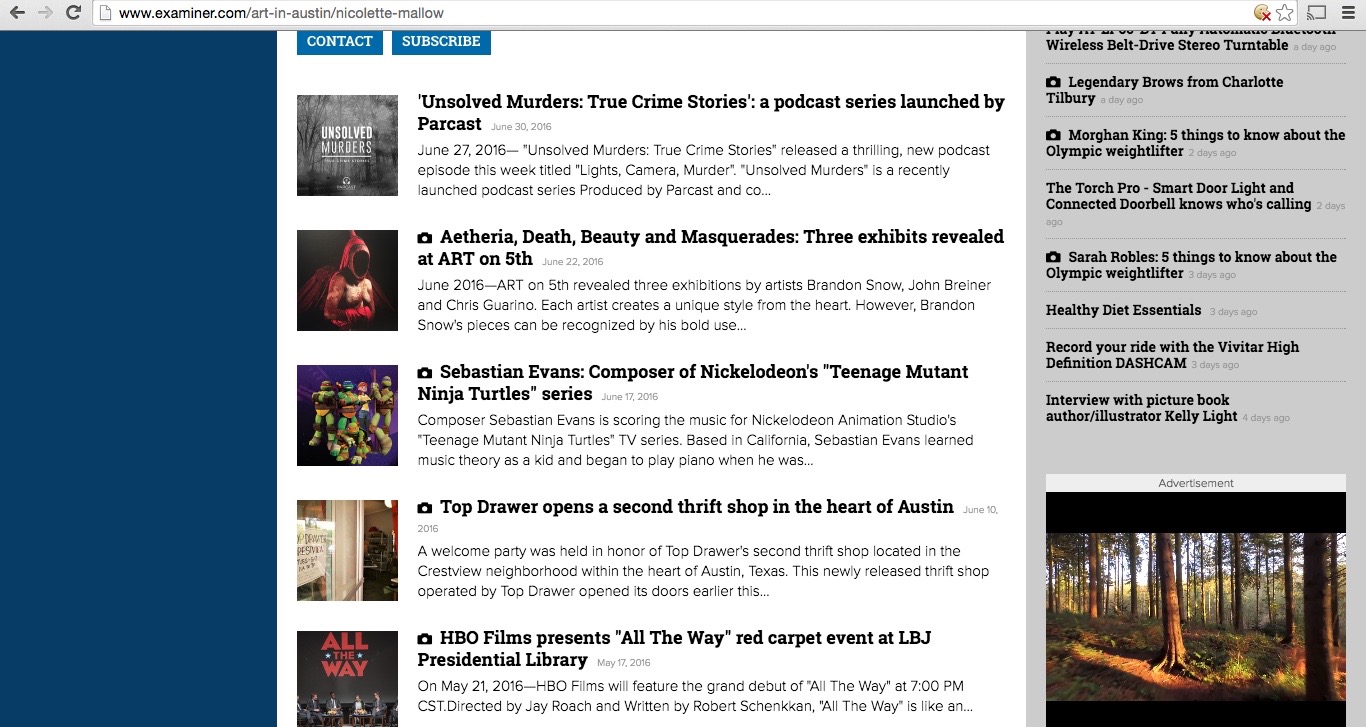
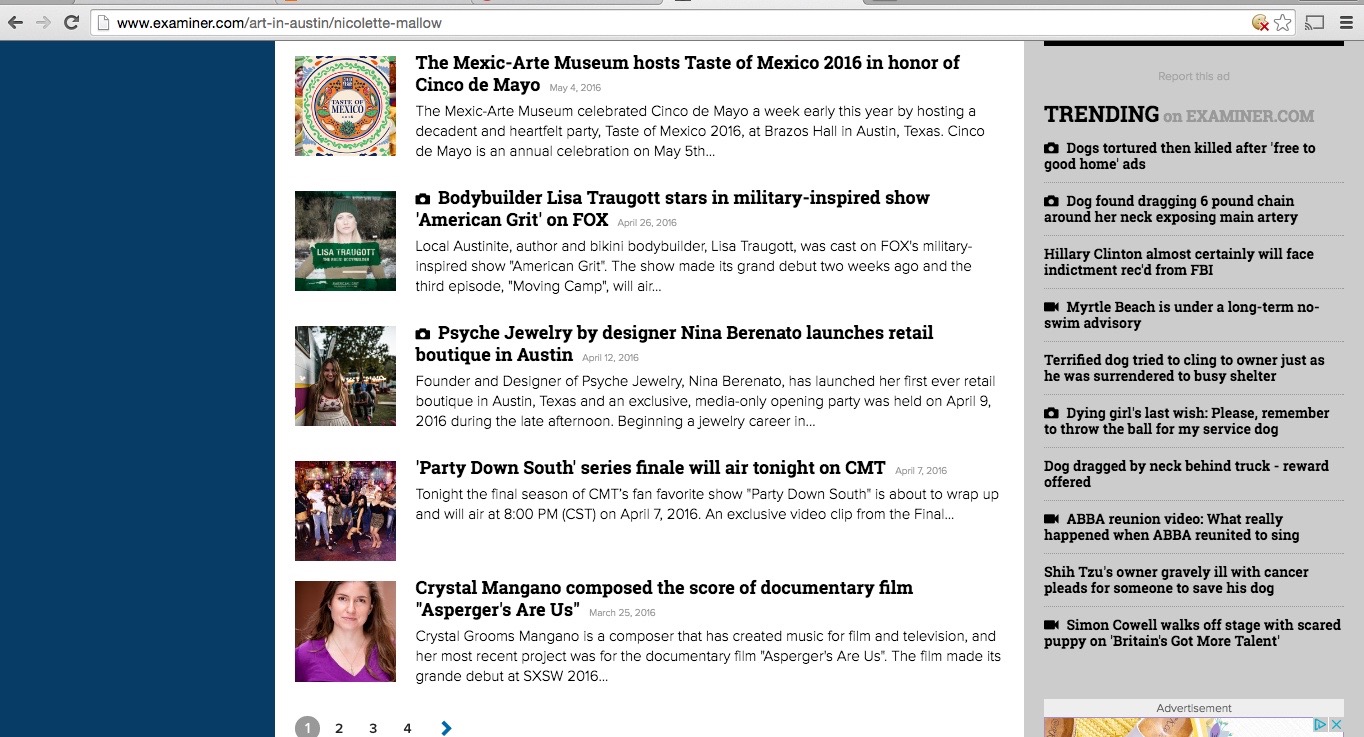
Examiner.com has closed their media platform after several years. From July 2015 to Jult 2016, I worked for Examiner as a contract writer. My area of assignment was to cover Arts & Entertainment. Since Examiner.com’s website no longer exists and has faded into the dark abyss of the internet, all of my stories are gone. That is the bad news. However, the good news is that since I own the rights to all my stories and interviews: I will be reposting each story here on my website, one-by-one. Hooray! To begin, I wanted to trail back to the beginning. And this first post is an accumulation of screen shots from the original website of my Writer’s Bio that contained a list of my publications. I will begin reposting the stories from last year to present day, the order in which they were written as posted on Examiner.com.

I will miss writing for Examiner.com and was very saddened that it came to an abrupt end, but I look forward to a new literary adventure and many more wonderful stories.