SXSW interview with Director of ‘A Song For You: The Austin City Limits Story’

nicolette mallow

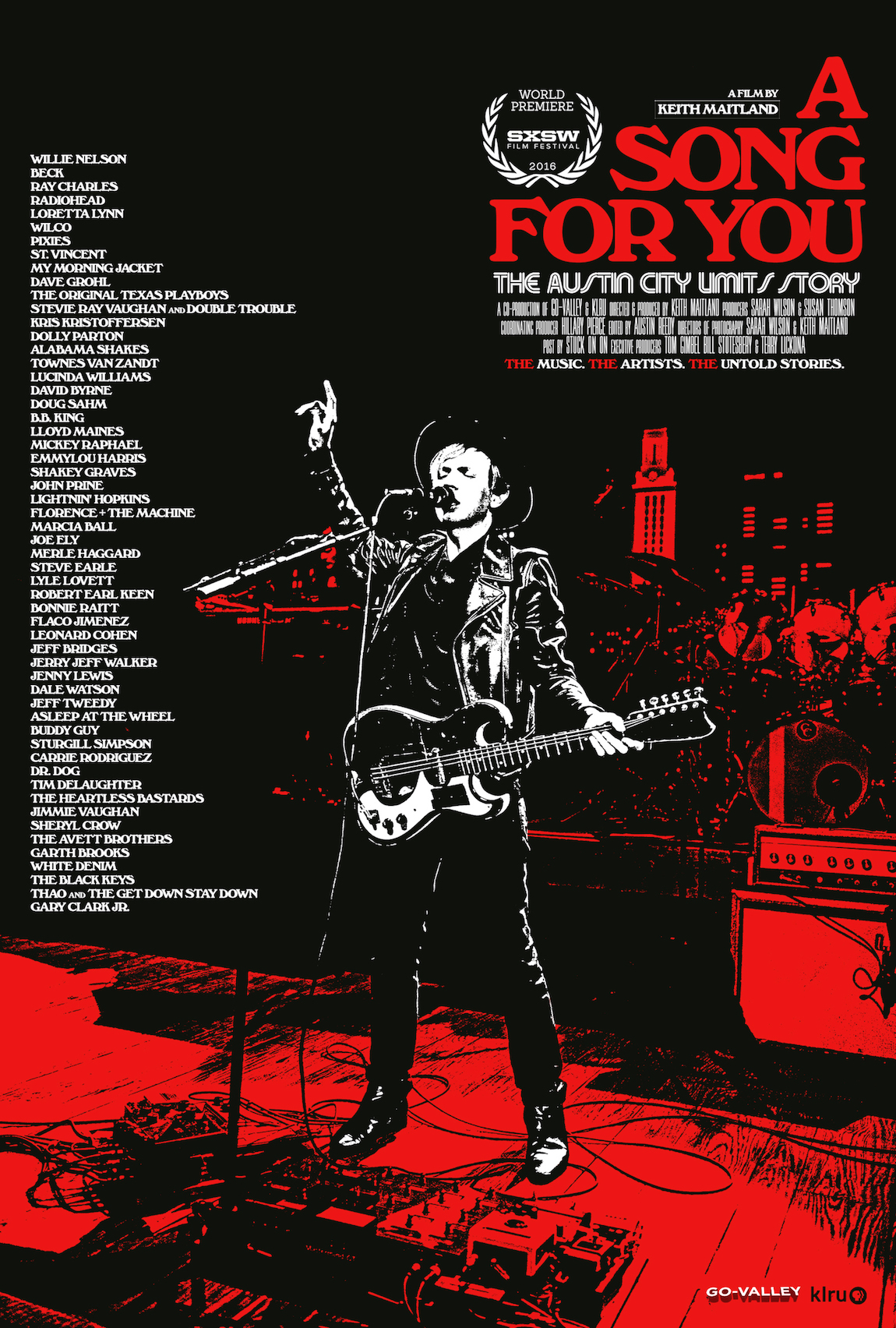
BECK. Imagery provided by Go-Valley Films.

Directed by Keith Maitland, “A Song For You: The Austin City Limits Story” held its world premiere at The Paramount Theatre in Austin, Texas during SXSW on Mar. 17, 2016. The SXSW Music, Film and Interactive Conferences and Festivals is celebrating its 30th year. And this year Keith Maitland and his teammates debuted two films for the first time at SXSW 2016. “A Song For You: The Austin City Limits Story” is a vibrant, intimate and engaging documentary covering 40 years and four decades of live music filmed for the beloved television show Austin City Limits (ACL). It’s a playful and raw story—an immaculate collection of great artists and their bands that took the stage at Austin City Limits. Director Keith Maitland shares the unique story of how ACL began with ‘janky’ sound equipment and soon morphed into the longest running music show in television history.

Artists that appear within the documentary include the following: Willie Nelson, Townes Van Zandt, Steve Ray Vaughan, Beck, Johnny Cash, Bonnie Raitt, Ray Charles, Emmylou Harris, Buddy Guy, Jeff Bridges, Matthew McConaughey, Lyle Lovett, Sheryl Crow, Dolly Parton, Radiohead, B.B. King, Lighting Hopkins, The Avett Brothers, Talking Heads, Garth Brooks, Thao Nguyen and more. “Long-time producer of Austin City Limits, Terry Lickona, also transcends the TV show and gives audiences a front-row seat and backstage pass to the greatest performances of the longest running music show in television history.”

One prime reason “A Song For You” is described as the ‘ultimate backstage pass’ to Austin City Limits is because it entails endless video clippings from numerous performances filmed live at ACL alongside annotations of those who were there first-hand to experience the performances. The audience is granted the inside track regarding many ACL shows, off-stage and-onstage. Watching the artists and the production team work their magic. Feeling as if we were there, too. Hearing about the highs-and-lows of the non-stop adventure—’the flood of memories’—it’s an adrenaline rush to the heart and soul. Listening to the music, hearing the interviews and seeing it all unfold and come to life at once makes the documentary unforgettable.

Director Keith Maitland did an immaculate job of intertwining 40 years of history into 96 minutes. “A Song For You” opens with Dale Watson solely because he was the featured artist on the final episode filmed for Season 39 by Austin City Limits. Once Maitland sets the scene in present day, the Director takes us all the way back to the beginning when Willie Nelson played for ACL in 1974 and tells the story in a retrospective way. Obviously, music is the core of Austin City Limits: their universal love of music and their never-ending desire to showcase musical masters and the up-and-coming talent. The title of the film is also befitting because without the audience, Austin City Limits wouldn’t have thrived. The show needs the audience as much as we need the show. You won’t want this film to end it’s that exciting, but when it does. As the credits come to a close, there is a video of Ray Charles singing “Deep In The Heart of Texas”. Which is where it all began, deep in the hearts of Texans. Or at least those living in Texans even if born elsewhere… Many of the artists in the film are still living, others have died and passed on. But the story of Austin City Limits will live on forever.

asfyou_acl__final_Hi copy

Imagery provided by Go-Valley Films.

Fortunately, this week the Director Keith Maitland met with Austin Examiner, Nicolette Mallow, at The Driskill Hotel to talk about “A Song For You: The Austin City Limits Story” and how this delightful documentary came to fruition. Maitland also touched briefly on his other film, “Tower” that screened at the SXSW 2016 festival, too. [“Tower” is about the sniper in August of 1966 who rode the elevator to the top and held people hostage from The University of Texas Tower for 96 minutes, and at the end of his tyranny he’d taken 16 lives and wounded over three dozen.]

Nicolette Mallow: What compelled you to make a film about Austin City Limits? Do you simply love the show and what it stands for? Or do you have a strong affiliation with the city of Austin, too? I noticed both of your films pertained to Austin, Texas.

Keith Maitland: I attended The University of Texas at Austin from 1994 to 1998. Then I lived in NYC for ten years. About ten years ago, I moved back to Austin. And yes, live music is something I’ve always loved … In the 1990’s, I saw a few ACL tapings. I even sneaked backstage a few times. Once I snuck onto Willie Nelson’s tour bus in 1998. I had a knack for sneaking backstage. And that’s really what I wanted this documentary to capture: the energy and excitement of a wide-eyed fan… How this project came about is that I used to work at KLRU. And then a few years ago, a PBS Executive in DC called me about Austin City Limits and their 40th anniversary.

NM: How were you able to pick and choose a specific list of videos from an endless supply of ACL performances?

KM: That was no easy task and there was simply no way to honor all of the artistic talent that has premiered on the show. Austin City Limits has showcased around 800 performers and their bands. That’s a rough estimate and not an exact number, but my point is that it was impossible to include everyone in 96 minutes. I asked the production crew for a list of their favorites, and that was hard for them as well. So rather than pick out favorites, together, we oriented the set list around pivotal moments of the show.

NM: I noticed the documentary focused a great deal on Beck, Willie Nelson, and Stevie Ray Vaughan. All very big artists that are loved by Austin and around the globe… Personally I loved the footage in your film of Beck’s performance at ACL. And I actually went to middle school and high school with Willie’s nephew, Trevor. Any reason you chose those three to focus on?

KM: Beck is one of my absolute favorite artists and his presence in the film portrays the musical energy of present day. It was so cool to book an interview with him and quite rare for us to get the chance. Beck is very exclusive about interviews. I think it had been about ten years since Beck had consented to an on-camera documentary interview. So that was a huge honor and I know the only reason we were able to book it is because of Beck’s love for Austin City Limits… In regards to the other two artists. There are two statues of musicians in downtown Austin: Willie Nelson and Stevie Ray Vaughan. Their names were paramount to the story because they have each cast a shadow over the legacy of this town… Plus, Willie Nelson is the first artist to perform for the show and he’s from Austin. Also, the producers of ACL absolutely adore those two. And I can tell they had a very personal friendship with Stevie Ray Vaughan and that the absence of his presence still stings the ACL family.

NM: Did you enjoy interviewing the production crew, and specifically (the producer) Terry Lickona, from the ACL crew?

KM: Yes. I did. One of my favorite parts of the film is at the end when we are asking all the employees at ACL about what lead them to their job and what their role in the company is… Terry Lickona is just a great person in addition to being a fantastic producer. He is also a live music devourer. And he is always looking to the future and ‘what’s next’ which keeps the show fresh and exciting. He is a people’s people and is constantly out there absorbing the latest news pertaining to music. Terry’s loyalty to the show— and the loyalty of the entire ACL crew—it’s astounding. They’re an amazing team. And come on, it’s a pretty sweet gig to work.

NM: My last question is about your other film “Tower”. The other day I saw “A Song For You” at the Violet Crown and I adore it. But I’ve yet to see this one. My question is, many people have made movies or written stories about the 1966 sniper that murdered people from the UT Tower on the UT campus. What defines your story from all the rest and makes it so unique?

KM: Yes a lot of people have covered this story. What makes my take on it unique is that I don’t focus on the sniper. I focus on the witnesses, the heroes and the survivors of the story. The sniper is obviously mentioned and he’s part of the story. But he’s almost like the shark in the movie “Jaws” and how we don’t really see him until the end. We just hear the music and know what’s coming. “Tower” is a story of humanity at its best and worst. We get to see the people who put their lives at risk to save another. We also get to hear accounts from those who were frozen in fear, unable to help, and the shame they felt for being paralyzed with fear. But it’s very touching to hear the stories. A lot of people risked their lives to come to the rescue of those bloodied, bleeding and wounded… There is a little bit of us all in these characters and I wanted people to be able to relate to the story. Not the sniper.

For more information regarding “A Song For You: The Austin City Limits Story” please visit the official website at www.asongforyoufilm.com. To learn more about Austin City Limits (ACL) and to search upcoming performances: please check out their web page at www.acl-live.com.

Note: This article was originally published on Examiner.com in March 2016. 
nicolette mallow

Composer Kerry Muzzey talks about writing the score for ‘The Seer’ at SXSW

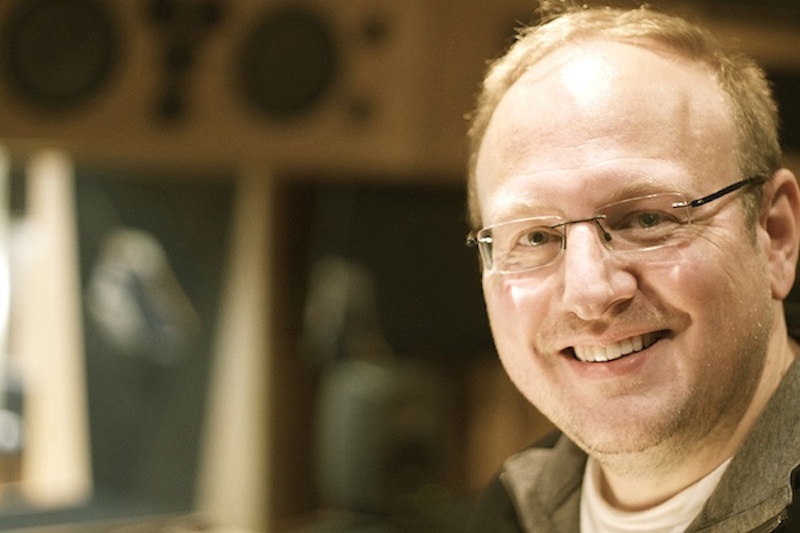
Kerry Muzzey _headshot

Kerry Muzzey. Photography by Simon Whiteside.

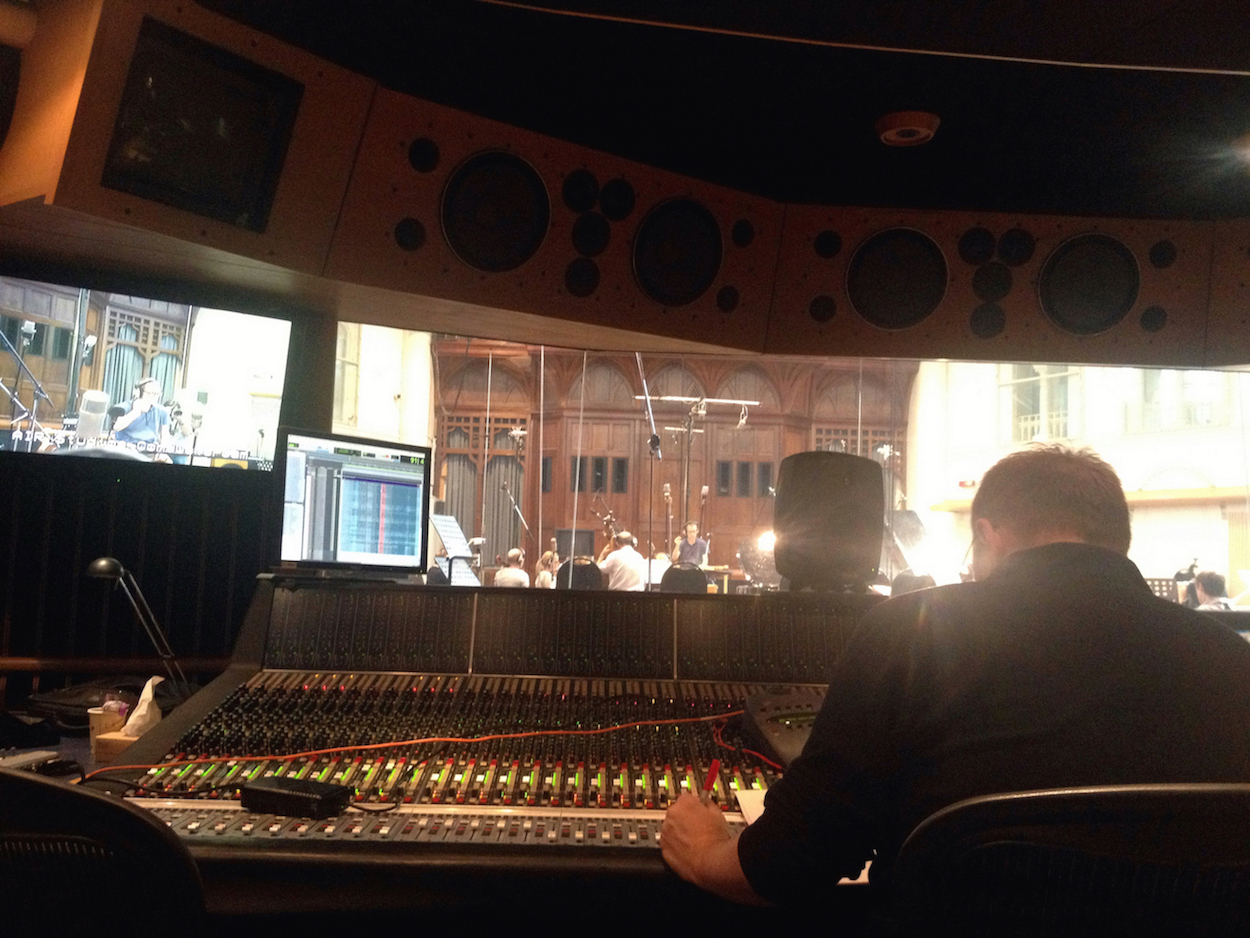
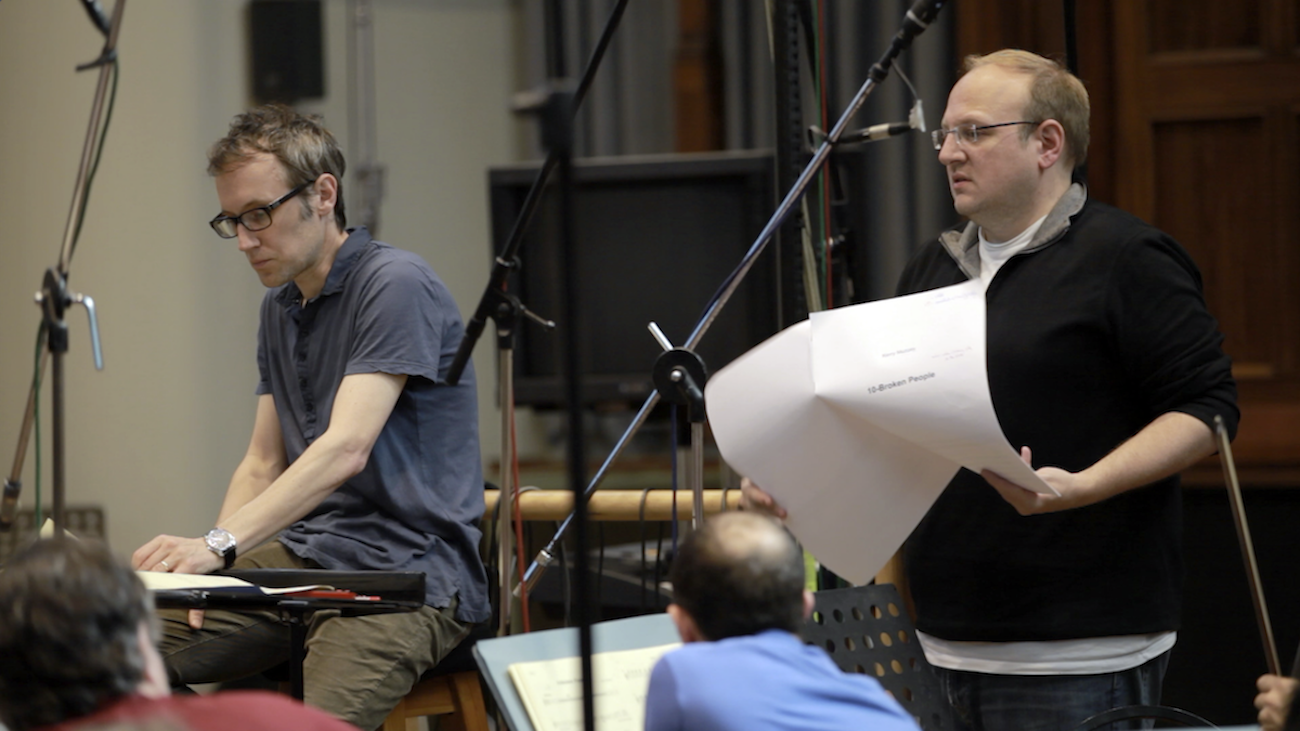
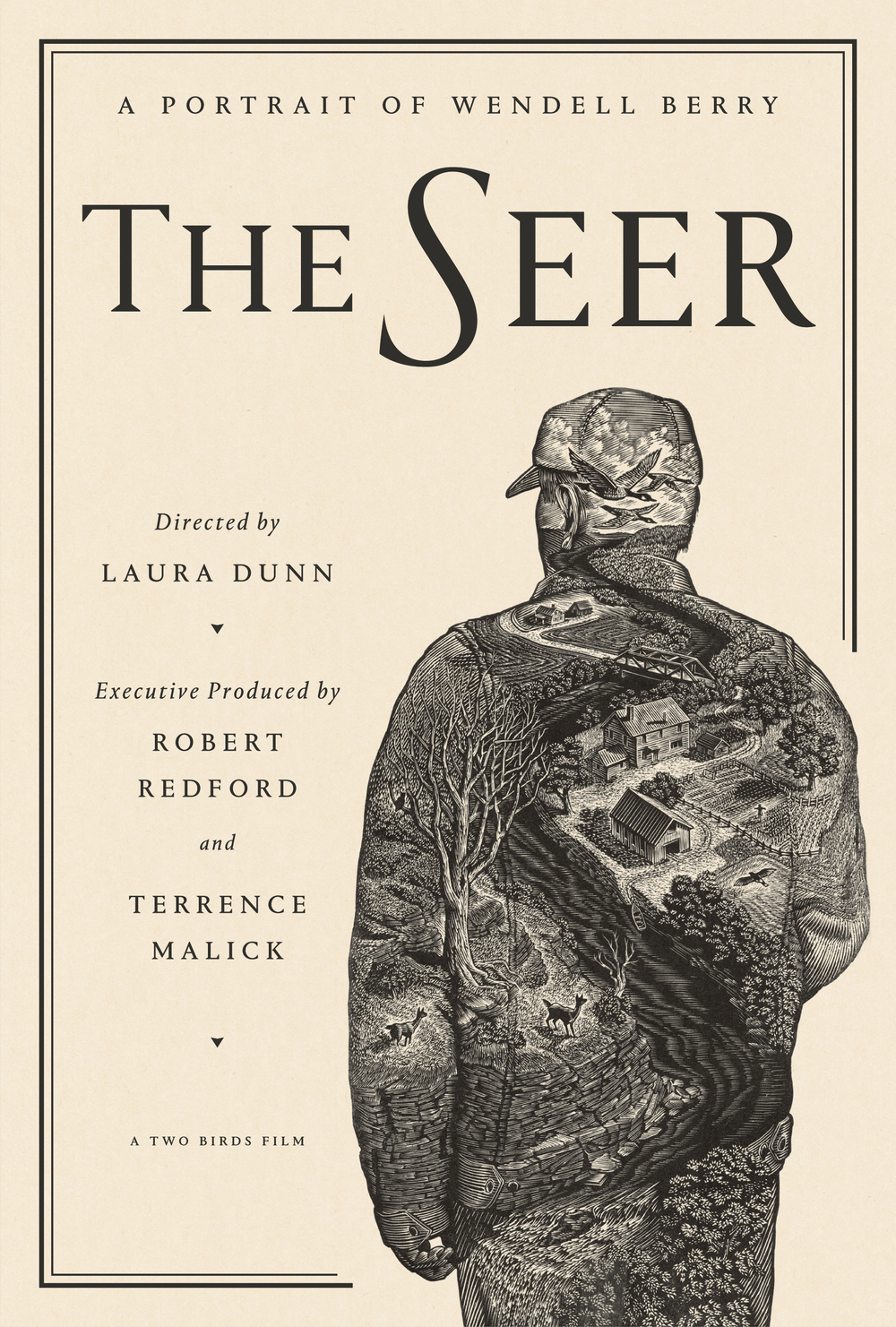
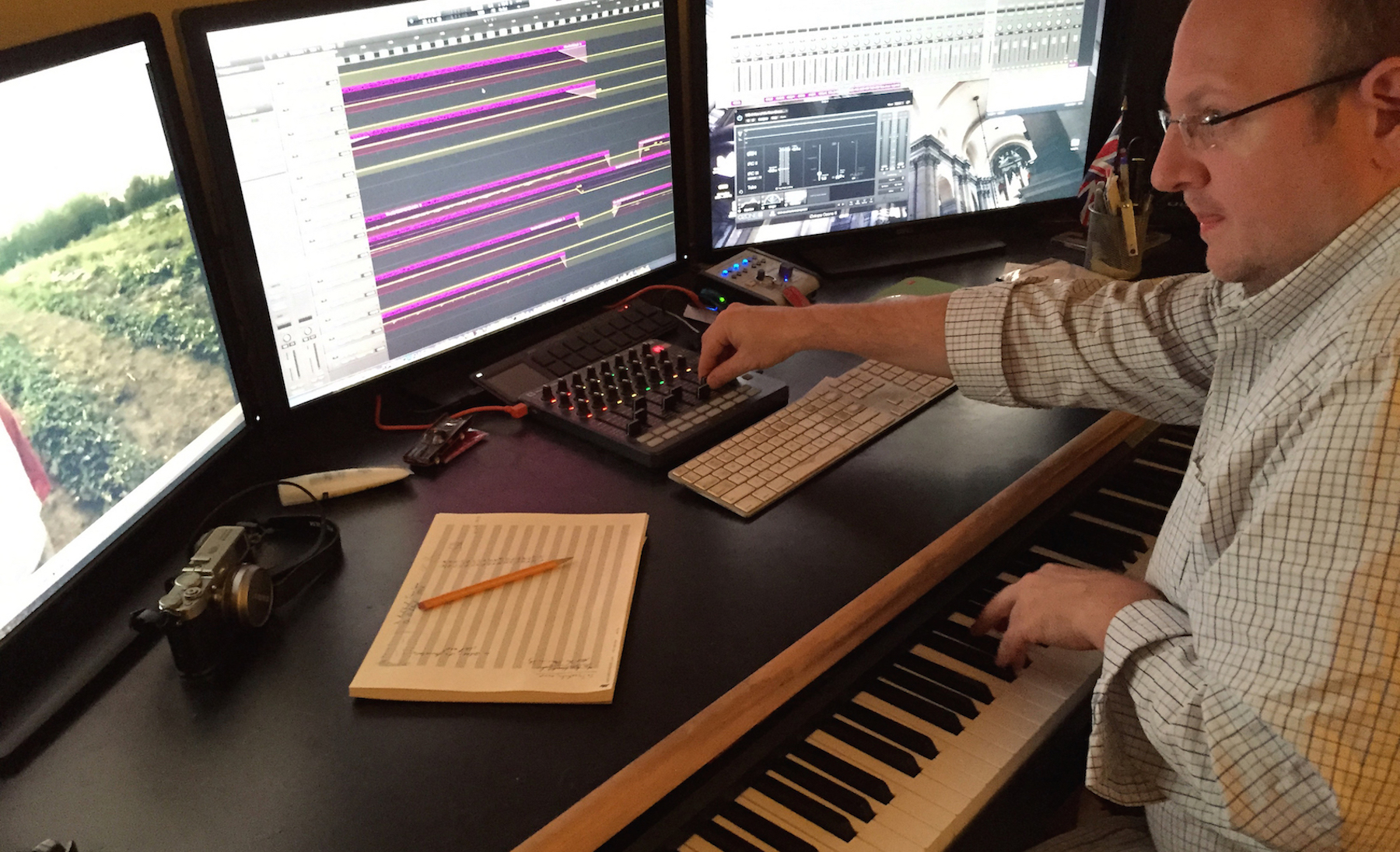
World-renowned modern and classical composer, Kerry Muzzey, wrote the musical score for “The Seer: A Portrait of Wendell Berry”, a documentary directed by Laura Dunn and executive produced by Oscar winner Robert Redford and Oscar nominee Terrence Malick. “The Seer” held its world premiere on Mar. 12, 2016 at SXSW in Austin, Texas. Composer Kerry Muzzey and the crew of “The Seer” hit the red carpet several times to promote their newly released, award-winning documentary. The SXSW Music, Film and Interactive Conferences and Festivals is celebrating its 30th year. And this year “The Seer” was awarded the ‘Special Jury Recognition for Cinematography’ for SXSW 2016.

Music is a key element within the world of cinema and Kerry Muzzey knows how to set the scene, musically, with his innate gifts of sound and music. The score for “The Seer” is absolutely lovely and befitting to the story without dominating or overpowering the documentary. On Mar. 15, 2016, Kerry Muzzey consented to a phone interview with Austin Examiner, Nicolette Mallow, to talk more about creating the score of “The Seer” and his musical background that lead him to Hollywood and SXSW.

  • nicolette mallow

A little more about the synopsis of the film in preface to the interview: “The story of ‘The Seer’ revolves around the divergent stories of several residents of Henry County, Kentucky who each face difficult choices that will dramatically reshape their relationship with the land and their community… Henry County, Kentucky, like many rural landscapes across America, has become a place of quiet ideological struggle. In the span of a generation, virtues of simplicity, land stewardship, local economies and rootedness to place have been supplanted by a capital-intensive model of industrial agriculture characterized by machine labor, chemical fertilizers, soil erosion and debt—all of which have frayed the fabric of communities. Writing from a long wooden desk beneath a forty-paned window, Wendell Berry has watched this struggle unfold, becoming one the most passionate and eloquent voices in defense of agrarian life… Filmed across four seasons in the farming cycle, ‘The Seer’ blends observational scenes of farming life, interviews with farmers and community members with evocative, carefully framed shots of the surrounding landscape. Thus, in the spirit of Berry’s agrarian philosophy, Henry County itself will emerge as a character in the film – a place and a landscape that is deeply interdependent with the people that inhabit it.”

Nicolette Mallow: When did you begin playing music? Would you mind telling me a little bit about your artistic background?

Kerry Muzzey: When I was 10 years old I started learning on classical organ. By the age of 11, I began writing music. But really it goes back even further than that because when I was 6 or 7 years old, I recall going to see “Star Wars”. Sitting there in the theater as a kid, when the film started rolling and the music came out of the speakers: it gave me goose bumps. I’ll never forget the feeling, even now. The music blew me away and all I could think about the rest of the day was “Star Wars” and its musical score. I have extreme reverence for John Williams. And I believe many composers can say that John Williams’ music was and is a true inspiration. Right after that movie I went out and bought the soundtrack on vinyl and listened to it on those giant headphones from the 1970’s. The music sounded like classical but it was more specific and inspiring. It was very intense and evocative for a child because it was focused and in conjunction with the picture… As a child I wanted to be a composer, a spy and an airline pilot. I dreamt of becoming many professions just like any little kid would. Yet I always kept coming back to music. My mother raised me entirely on classical and she told me that when I was in her womb: she played classical music for me and held the headphones next to her belly for 30 minutes a day for nine months.

NM: It seems as if you were destined to be a composer.

KM: Yes, and even though I started writing at the age of 11. It wasn’t until I turned 16 that my mother’s friend moved away and gave us their piano. I remember getting that piano and my family could not pull me away from it… Just the sound of a piano allured me. Complex piano compositions resonated with me so deeply even then. Because when you are playing a physical instrument: you can feel the hammers and strings inside its giant wooden case. It resonates in your heart and your hands. You can literally feel the sound as you’re playing music. It’s very powerful. That is around the time I began writing solo piano stuff. Playing the orchestra I heard inside my head. At the time, technology for music was not yet available to create an orchestra inside of a computer. So, it was a little different back then.

NM: I listened to the score you composed for “The Seer” in its entirety, twice. You wrote such beautiful music that compelled my mind to travel through time and feel nostalgic. The song “Daughter” struck a chord with me, in a good way… Was the music meant to be evocative? What is the biggest difference between writing music for a narrative feature versus writing a score for a documentary film?

KM: That is an awesome question. Writing music for a documentary was a challenge that took me quite a few tries to overcome. A narrative film is a completely different process than composing music for a documentary. Writing music for a documentary has to be subtle. The music cannot overpower the picture and it has to stay out of the way of the picture. The score cannot be traditional. For instance, a narrative feature film has a soundtrack of very specifically engineered music. It is written to make the audience feel something at that moment, so when the hero saves the world or the couple finally gets their big kiss: you expect the soaring strings. When making music for a documentary, if you’re too on the nose, or if you’re trying to punch it up too much, it can become a distraction. The audience that attends documentaries and is loyal to documentaries is also a highly intelligent crew. And you cannot use music to try and manipulate the audience into feeling a certain way. The music is simply there to beautify and assist the story as it unfolds in its own natural state.

NM: If you had to pick one song from the soundtrack of “The Seer”, which track encapsulates the spirit of the film? I’m curious to know which song is the beating heart of your composition.

KM: Yes, I can pick one. I believe it’s the sixth track and it’s a song called “Forty Panes”. It’s also the Director’s favorite (Laura Dunn). It’s a song about Wendell Barry and it has piano and cellos in the melody. It was magical to write and it kind of came out of nowhere. I was so in love with it that I actually got my cellist to record it before I even played it for Laura. Which is kind of dangerous because I am paying the cellist for his time. But I loved this cue so much. The way it resonates with the picture and how it struck a perfect balance… It’s the crux of everything and it’s beautiful… I sent the piece out to the Director and I was stalking my email waiting for Laura’s response. Two hours passed by and I feared the worst. And then her email arrived with a response, “I keep watching it over and over—and I kept crying every time I felt the music—and I don’t know why.” Right then, I knew that I got it right… The Director of “The Seer” is not only a good person, but she’s extremely smart and talented. She’s amazing and cool and I wanted her to love the soundtrack. Talking to her the other day, we spoke of that piece in particular as it being the high point in the films soundtrack: simple and quiet, but against the picture it can’t be anything else but exactly that… This wasn’t my first project with Laura Dunn, either. About eight years ago, Laura made a film, “The Unforeseen” about over development in-and-around Austin. The core of it predicted the housing crash a year prior to the fact. At the time she had licensed a few pieces of mine to use. Years later we reconnected and in this case she wanted me to score the entire film. Obviously I said yes and it’s been an amazing project. Laura and her team are so great at what they do.

NM: Do you have any upcoming projects that we can look forward to?

KM: Yes, I do have future projects. Presently I cannot say much because it hasn’t been formally announced yet. What I can say is that I am writing a full-length ballet for a full orchestra. And it premieres in London next May of 2017. This job sort of came out of left field. It’s a very heavy lift for me, it’s a huge challenge, but I am so excited to work with this choreographer and their innovative team. I couldn’t say ‘yes’ fast enough.

For more information regarding Kerry Muzzey or the movie, “The Seer: A Portrait of Wendell Berry”: please visit www.kerrymuzzey.com or www.theseerfilm.com.

Note: This article was originally published on Examiner.com in March 2016. 
VNTANA and DJI create a hologram drone lounge at SXSW 2016

DJI_VNTANA Hologram Drone 1

DJI Phantom 4 drone and VNTANA hologram technology at SXSW 2016 in Austin, Texas. Photography provided by VNTANA and DJI.

In partnership with DJI, the world leader in aerial imaging—VNTANA, an interactive technology hologram company out of Los Angeles created the first ever interactive hologram drone experience at SXSW from Mar. 12-14, 2016. The SXSW Music, Film and Interactive Conferences and Festivals is celebrating its 30th year in Austin, Texas. And this year SXSW featured its first ever interactive hologram drone pilots between DJI and VNTANA.

“From fully-controllable life-size avatars to simultaneous global performances from the world’s top artists, VNTANA’s technology creates the most engaging and realistic holographic experiences in the world. With our technology people can truly be multiple places at once and bring products and characters to life in new interactive ways. VNTANA’s team of designers, engineers, business strategists, system integrators, and creative technologists is dedicated to bringing you the next generation of holographic technology.”

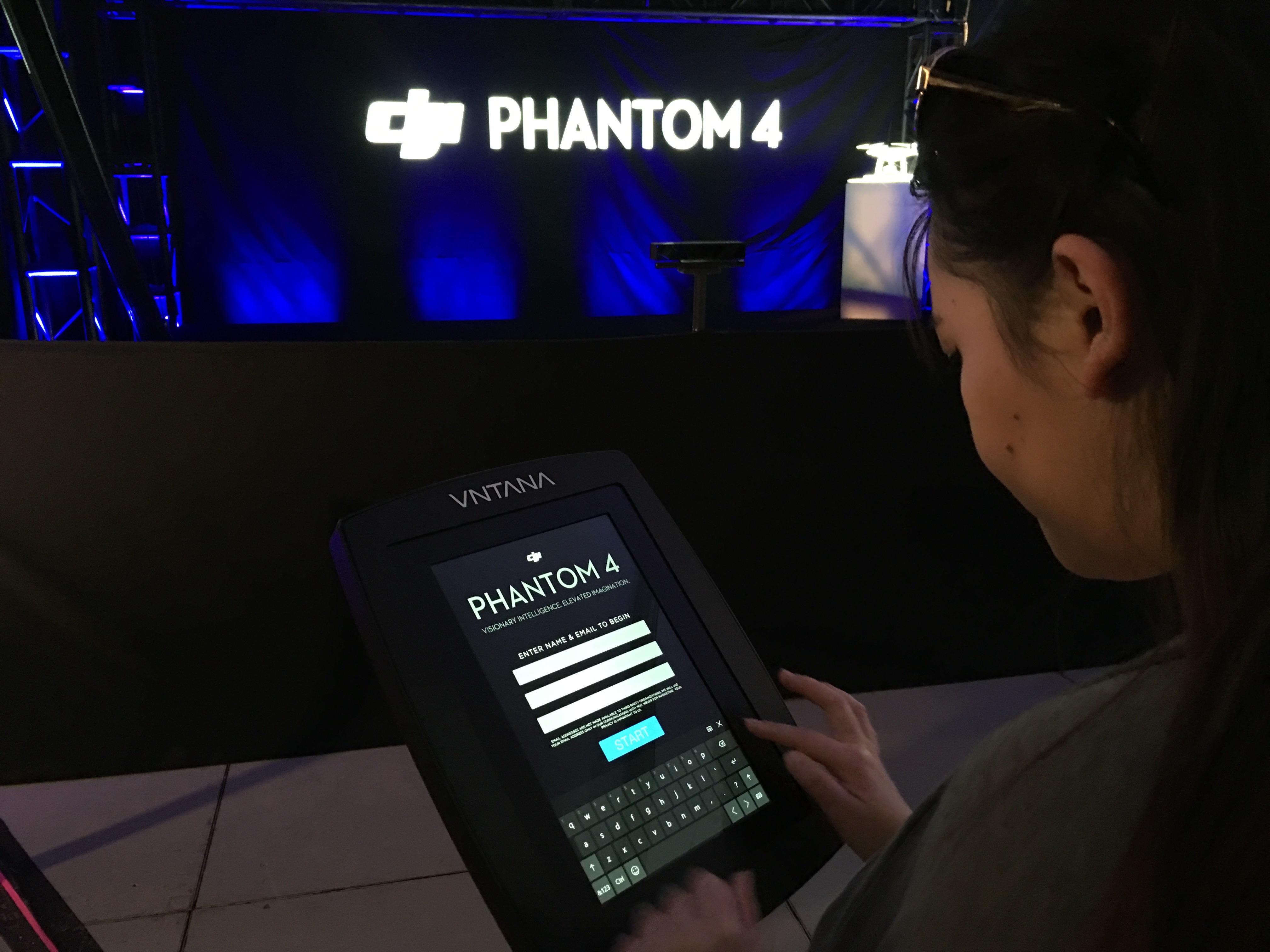
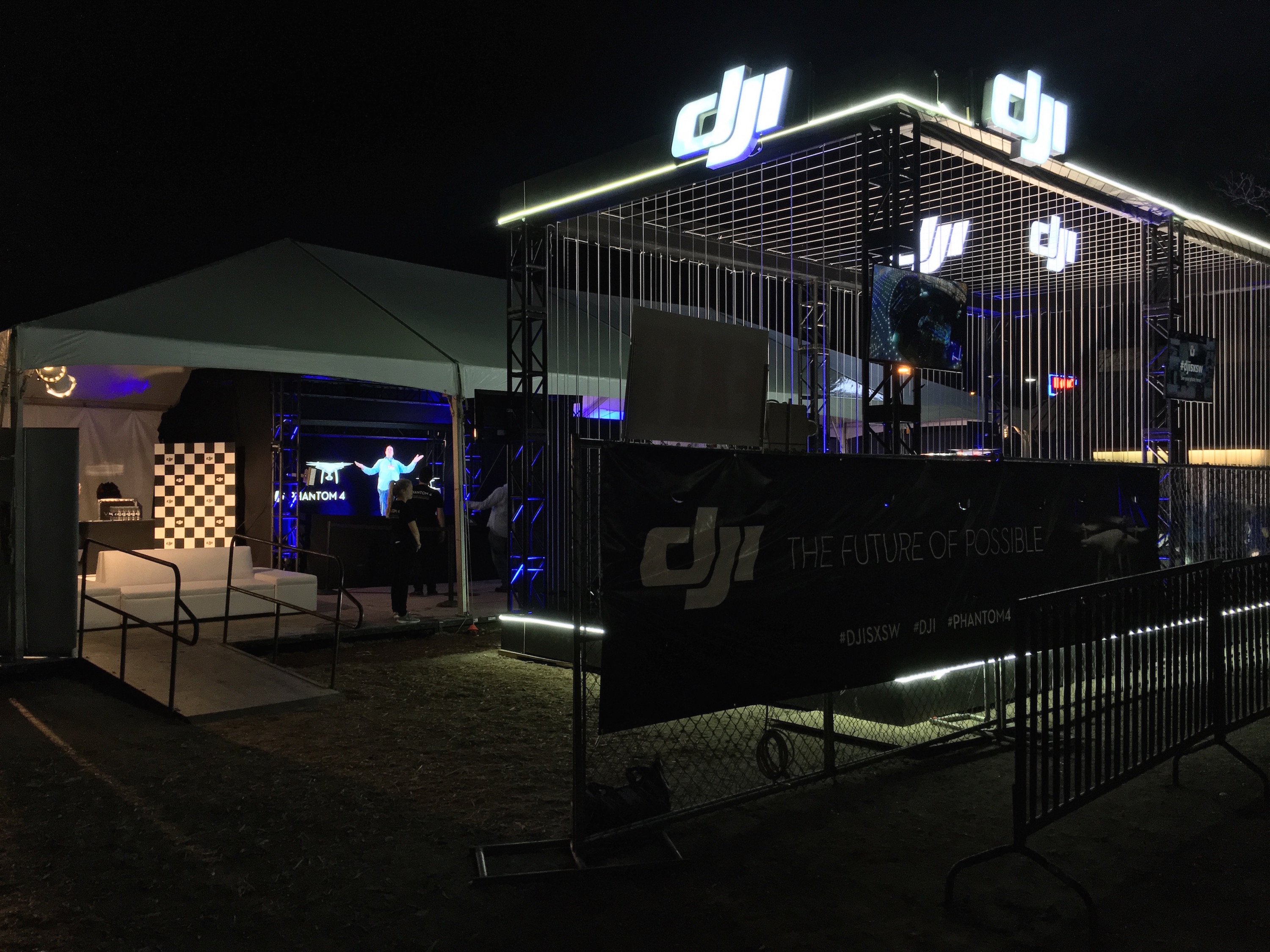
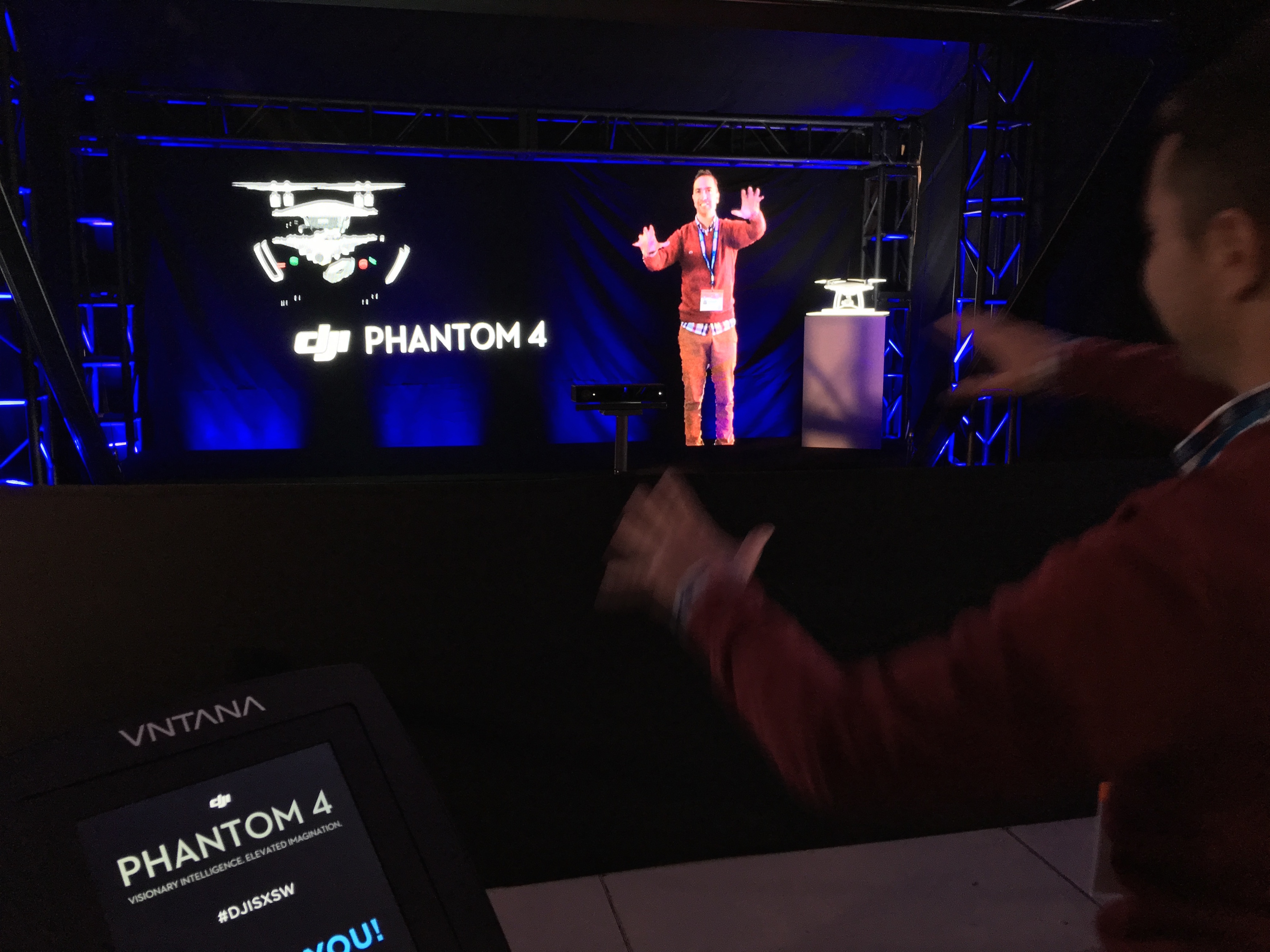
The interactive lounge was set up along Rainey Street close to SouthBites™. During this time SXSW attendees could see themselves projected as a hologram in real-time standing next to a hologram of the new DJI Phantom 4 Drone hovering next to them. The Phantom 4 is the first consumer quadcopter camera (or “drone”) to use highly advanced computer vision and sensing technology to make professional aerial imaging easier for everyone. Using gestures, attendees were able to control the hologram drone and even see the interiors of the drone. At the end of the experience, attendees received a hologram GIF via e-mail. To see video footage of attendees experiencing their lounge at SXSW, please visit Vimeo and watch “DJI Phantom 4 Interactive Hologram Drone Experience – Powered by VNTANA”.

A representative from VNTANA met with Austin Examiner, Nicolette Mallow, during the SXSW festival to briefly discuss how to operate the hologram and fly the drone. Mallow also got to experience the hologram first hand.

Nicolette Mallow: How exactly do guests pilot and fly the drone through the hologram?

VNTANA: The guests see themselves on the display as a life-size hologram standing next to the DJI drone. They are able to pilot the drone through gesture control. In this case, guests use vertical hand and arm gestures to fly the drone up and down along with lateral body movement to fly the drone left and right. If you clasp your hands together and then quickly split them apart, the drone also splits apart to show the separate mechanisms and motors inside.

For more information regarding VNTANA or DJI, please visit their websites at www.vntana.com and www.dji.com.

DJI Phantom 4 Interactive Hologram Drone Experience – Powered by VNTANA

VNTANA – Video: https://vimeo.com/158758465

Note: This article was originally published on Examiner.com in March 2016. 
nicolette mallow

Naomi Whittel: Founder of Reserveage Nutrition has a vision for global wellness

JP1_6287 (1)

Naomi Whittel. Photography by Jack Plunkett.

Founder and CEO of Reserveage™ Nutrition, Naomi Whittel has dedicated her career to naturally beautify the world with a vision oriented around science, health and wellness. Whittel is a ‘nutritional navigator’ who travels the globe studying various cultures and ecosystems to discover the best standards in nutritional health. Launching her company with four products in March 2009—Reserveage™ Nutrition now offers an extensive list of products ranging from skin hydration, metabolism boosters, anti-aging, cardiovascular support, antioxidants, and much more. Naomi Whittel has received several prestigious awards for her role as a successful female entrepreneur, including the following: the Gold Stevie Winner as Female Executive of the Year and the Silver Stevie Winner as Female Entrepreneur of the Year. “Naomi Whittel is one of the nation’s leading female innovators in the natural products industry. With two decades of experience in developing and managing sustainable companies in the health and wellness sector, she is the founder and CEO of Reserveage Nutrition™ and two sister companies: ResVitale™ and ReBody™. Together these natural health supplement brands have earned over 30 industry awards in four years, and are recognized for their mission to produce life-changing products based on ground-breaking science.”

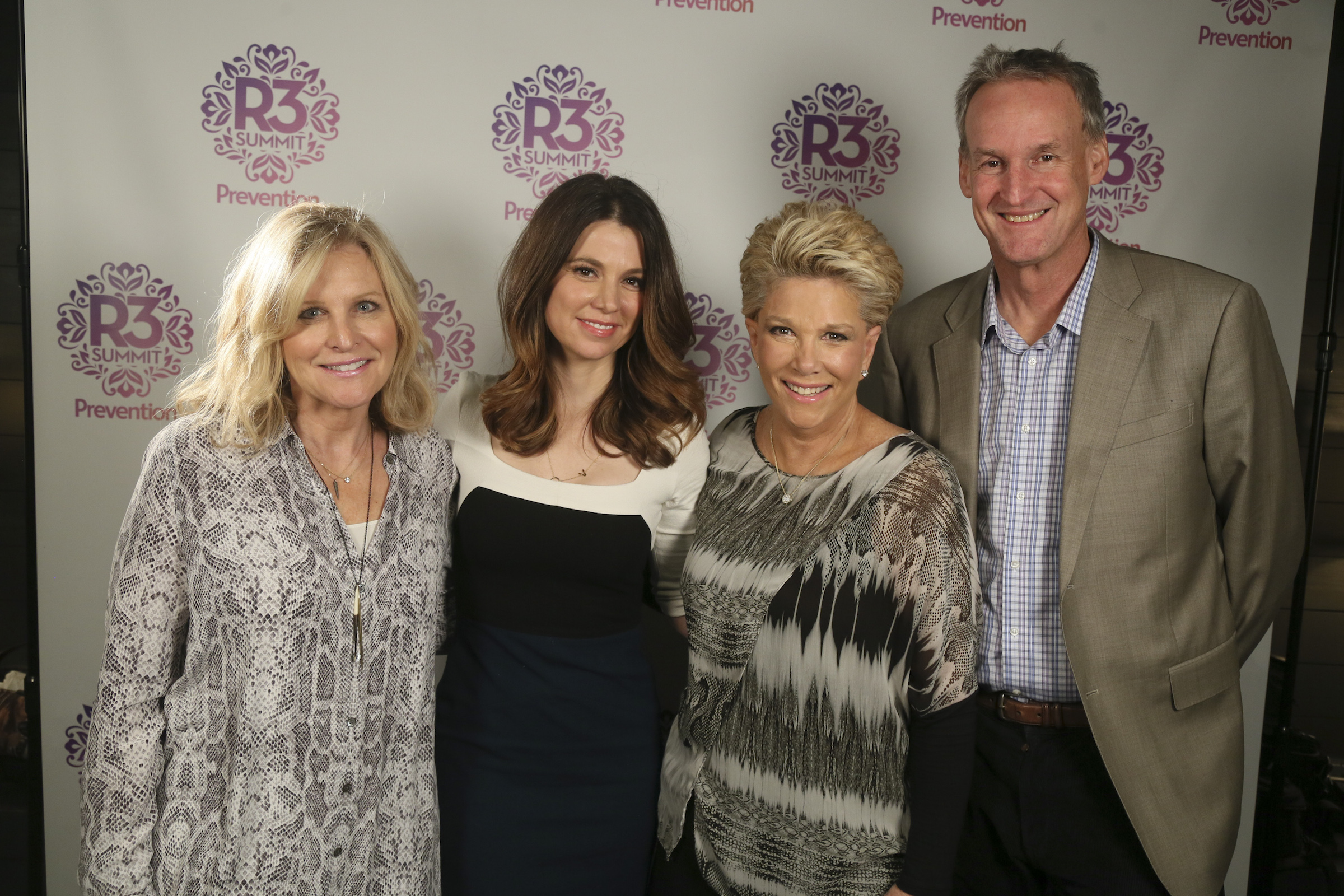
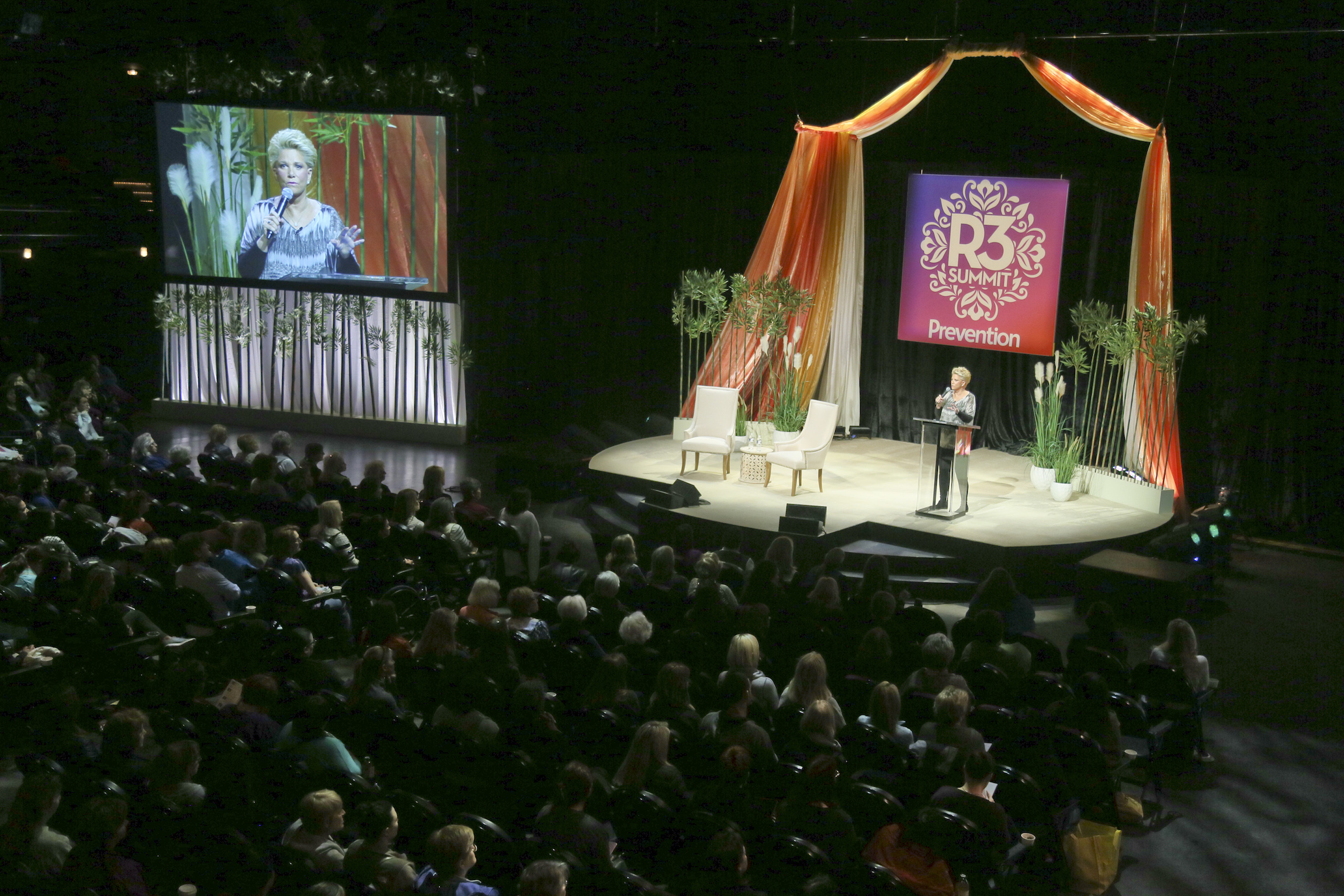
Recently, Naomi Whittel assented to an interview with a local Arts & Entertainment Examiner, Nicolette Mallow, to talk entrepreneurship and becoming a CEO at the age of 23. Whittel also shared some helpful tips and insights related to wellness. The interview was held within the Press room at Prevention Magazine’s third annual R3 Summit held at ACL Live at The Moody Theater in Austin, Texas.

Nicolette Mallow: On stage, you spoke of age and numbers. You emphasized that a number doesn’t define us no matter how young or advanced in age. Listening to you talk about starting a company that went global and being the CEO at 23 years old is so inspiring to all female (or male) entrepreneurs. However, I also recall during the presentation you mentioned that sometimes in the past you hid the fact you were the CEO because you felt your age might cause others to not take you seriously… How did you overcome the fear of being the youngest? It’s important for us all to learn from our elders or those with the experience of time that exceeds our own. But I have often felt the same way as an artistic professional when I’m the youngest, and often the only female, in a group where everyone else is older. It can be hard to be taken seriously and it can feel discouraging… How did you break free of all that and succeed?

Naomi Whittel: Being a young entrepreneur can be difficult. In hindsight, I wish that I hadn’t always kept it a secret that I was the CEO. But it’s a learning process for everyone starting out. First off, in order to succeed you have to be willing to fail and to be bold. To take risks. Failure is a huge part of success, but so long as you hold fast to your purpose and sustain boldness in all you do. In due time your visions and dreams will transpire. It’s also imperative to have a voice and to be honest with yourself. To know your strengths and weaknesses… Not long ago, I was in a meeting with other entrepreneurs and we were discussing investments. We needed to raise money for something that day and it seemed daunting to the others. At first no one was willing to invest, but I saw no reason to not make a move and act. I was the first one, and the youngest, to offer up a check to invest. Once I made the first move, the others were interested in the investment and we raised the money that day. Boldness goes a long way… Once you harness your internal power and know how to use it in a healthy way. Once you find a vision and hold onto it: falling into success becomes natural.

NM: Speaking of healthy, in regards to nutrition and wellness, it can be daunting for those just starting out with a mission to achieve a better diet or a healthier lifestyle. There are thousands of books, recipes and products out there for people to try. Where to begin? What is your advice for anyone wanting to change their lifestyle and nutritional diet but they don’t know where to start?

NW: Yes there is a lot of information there. I would advise the first step to be the elimination of processed foods. Processed foods do not carry natural nutrients, or often any nutrients, and therefore the body is not getting anything vital or healthy from these processed foods. Processed foods can do more harm than good. Solely because processed foods often carry a lot of chemicals and damaging, artificial substances within them, too. People aren’t always aware that what they are eating isn’t actually food at all… I was fortunate to grow up in a home of science and chemistry with parents focused on a biodynamic, organic lifestyle. However, I want everyone to join me on the journey to wellness no matter how or when their journey begins.

NM: My last question is, for those of us who sustain an overall healthy diet, exercise, drink plenty of fluids, take nutritional supplements and hydrate our skin, hair and nails. For those of us who feel we are nearly doing it all. What is something else that we can do to improve our diet and overall wellness?

NW: Intermittent fasting is something even the pro’s can forget to do. Fasting periodically from 8 PM to NOON has amazing benefits on the body. Intermittent fasting has proven to control blood sugar and insulin. It can promote weight loss and reduce cholesterol levels. Intermittent fasting can even assist with cellular repair or inflammation in the body, reducing stress.

For more information regarding Naomi Whittel’s background story or to view and purchase products online, please visit www.reserveage.com.

Note: This article was originally published on Examiner.com in January 2016.

nicolette mallow

Life coach Lauren Handel Zander speaks of self-discovery and the power of truth

JP1_6821 (1)

Lauren Handel Zander. Photography by Jack Plunkett.

Lauren Handel Zander is the Co-Founder and Chairman of Handel Group®, an international private coaching company. Zander is a life coach with a sense of humor and she specializes in bringing dreams and visions to life.On Jan. 16, 2016 whilst she was in attendance of Prevention Magazine’s third annual R3 Summit held at ACL Live at The Moody Theater in Austin, Texas: Zander consented to a short yet insightful interview with A&E Austin Examiner, Nicolette Mallow. Prior to the interview within the Press room, Lauren Handel Zander shared the stage with other talented professionals that included Joan Lunden, Naomi Whittel, Dr. Jennifer Ashton and Dr. Lauren Streicher to present the keynote “Love Your Age”.

Nicolette Mallow: During the presentation, you spoke of the past and hating the shape of your own shadow. That stuck in my mind. The way you described nitpicking yourself so deeply to the point it became absolutely absurd: disliking your literal shadow while walking about… I believe many people can relate to that sort of melancholy unkindness directed to the self. We often speak silently to ourselves, in our mind, and say such horrible things we’d never allow others to say to our face. Ultimately, my questions revolves around this: how did you overcome such negative self-feedback and rewire your mind to see things positively, accurately and with kindness? How did you conquer the inner-voice that was trying to hold you back and distort the truth?

Lauren Handel Zander: Yes; editing the voices can be a challenge. My journey of self-discovery began in my 20’s. The first step was being honest with myself and everyone around me. It’s easy to become afraid to be our own individual. To stay true to ourselves, we must be honest. In the past, I was hiding truths from myself, and others, because I was hiding myself away. I was lying to everybody. I was the epitome of a bad girl. One day I simply decided to reveal everything that was truthful. And that was when my life changed. I was born to be a life coach, it’s in my blood. I just had to learn to edit my own voices and learn to be true to myself, first, before I could coach others.

NM: Once we edit the voices, then we can get to the truth?

LHZ: Absolutely. One of the aspects I love most about my job is that I can get to the root of things. Throughout the process of life coaching, I want to know why someone is doing what they’re doing. I want to understand what’s going on beyond surface level and why they’re feeling whatever it is they’re feeling. I want to understand what they’re thinking. That way I can help find the blocks and I can fix it. Bringing shadows to light helps people reach their highest self. Whether it’s a relationship, a job, an investment, family issues or whether someone is unsure why they’re doing what they’re doing as if running on autopilot… I want to know everything so that we can work on fixing it. I like fixing things. But people have to be willing to do the work.

NM: So you help bring dreams and visions to life?

LHZ: Yes. I like to say that I have ‘a vision for my visions’. Having a vision and following our dreams helps us to reach our highest self. I want people to find the truth and find a vision so they can turn their dreams into a reality.

“Lauren Handel Zander is a life coach, university lecturer, public speaker and, above all, a purveyor of the truth. As the Co-Founder and Chairman of the Handel Group®, she has spent over 20 years coaching thousands of private clients: entrepreneurs, couples, families, professors, politicians, Emmy and Academy Award-winning artists, Grammy-winning musicians and Fortune 500 CEOs. Her corporate clients have included executives from Sony BMG, The New York Times, News Corp, J. Walter Thompson Agency, Citibank, Dropbox, LinkedIn, Uniworld, The Gap Inc., BASF, NYU Langone Medical Center, and Vogue. She is a mediator, who has fixed corporate business relationships, mediated contract negotiations, reconciled marriages, and helped resolve complex family issues. In the early 2000s, Lauren created a groundbreaking methodology, The Handel Method®, which she developed and taught at MIT. Her methodology, supported by top educators and psychologists is now being taught at Stanford Graduate School of Business, MIT, NYU, Columbia, Yale Drama School, and Wesleyan, as well as in over 35 other universities and educational progrlauren-zander-candid-2ams across the country.”

www.handelgroup.com

Note: This article was originally published on Examiner.com in January 2016.
nicolette mallow

Celebrity personal trainer Larysa DiDio talks fitness, healing and Kung Fu

nicolette mallow

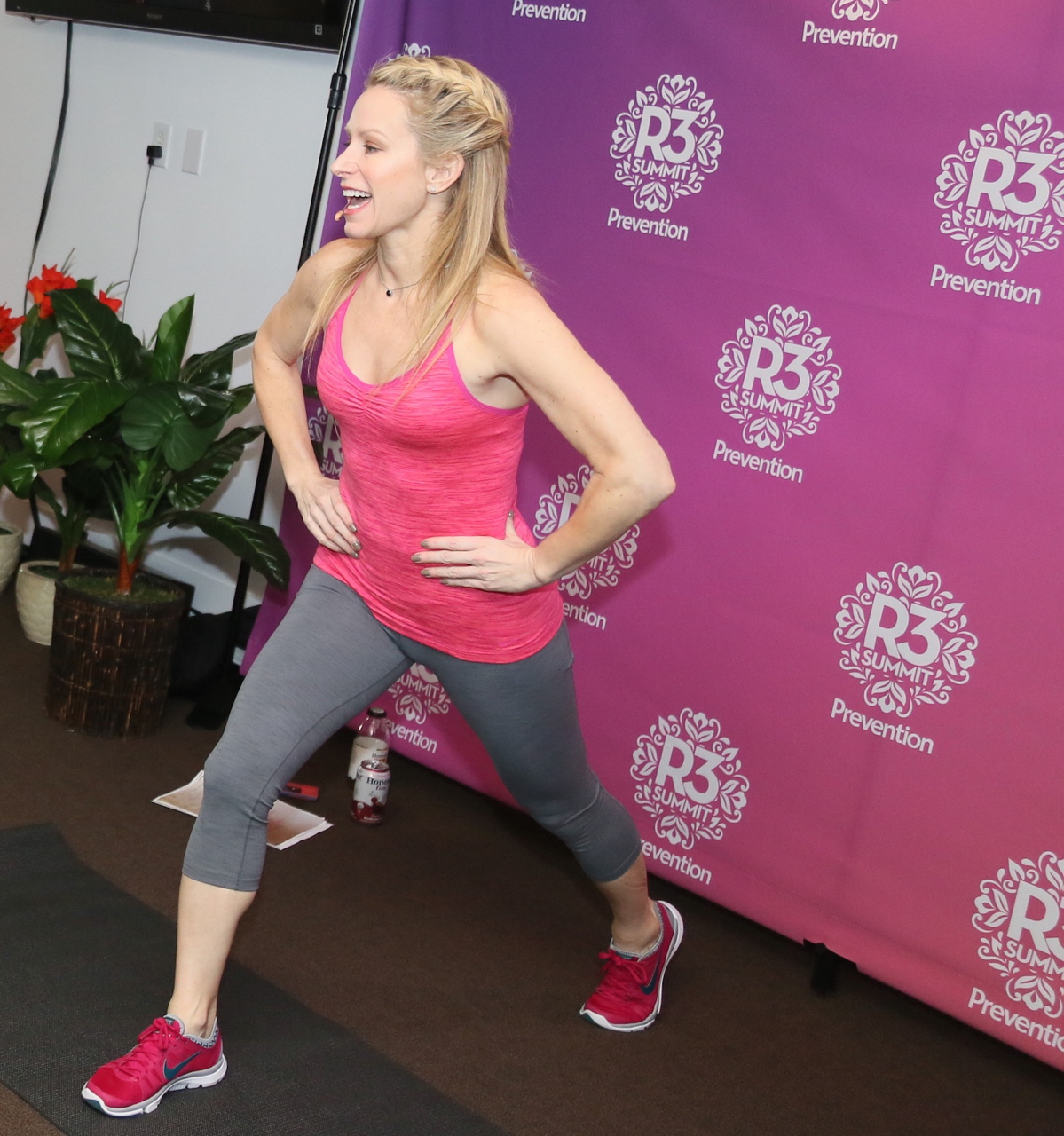
Larysa DiDio. Photography by Jack Plunkett.

Celebrity personal trainer and writer Larysa DiDio was a featured fitness instructor at Prevention Magazine’s third annual R3 Summit. Sporting hot pink Nike shoes, athletic gear and a stylish braid: DiDio taught her groundbreaking workout, Fit in 10, that maximizes results in only 10 minutes a day. Afterward, DiDio consented to an interview in the Press room with local Arts & Entertainment Examiner, Nicolette Mallow, on Jan. 16, 2016 at ACL Live at The Moody Theater in Austin, Texas.

Nicolette Mallow: You’re a remarkable athlete and clearly you posses a strong, resilient body to be such a steadfast, successful and powerful instructor. However, when athletes (male or female) get injured. It can be very difficult, almost emasculating, to feel weak doing something that used to come naturally to our bodies. How do you handle injuries, or what advice to you give clients (athletes) when they are in the recovery process after an injury or surgery? How do you keep the mind focused on the end goal without overworking the body in the process, or feeling as if the body lost its physical power?

Larysa DiDio: Week-to-week progress is how I look at my fitness goals when I am injured. Being kind to ourselves as individuals is also an important factor. Talk to yourself positively—turn the negative into a positive—and the healing process goes a lot smoother. Mind over matter really is a huge part of fitness and staying focused. For instance, I’ve broken my ankles twice. The first time I was really annoyed and frustrated. And that did not help me heal any faster nor did it alleviate the pain. Later on, the second time around when I broke my ankle playing outside with my son. Even though I was not pleased to break a bone: I knew what to expect and I had a positive outlook. I knew that in time my ankle would heal and it wasn’t something that would last forever. The second break was a lot easier and the healing process was far less stressful or straining.

NM: For the beginners just starting out fitness classes with no prior athletic training, it can feel overwhelming and intimidating being around those with athletic skills. What is your advice?

LD: The gym should be a haven for everybody, especially beginners. For beginners, the gym is not a place of competition. It’s completely natural for a beginner to be afraid and there’s no shame in that. I advise those just beginning to enroll in fitness classes and work out in groups. That way everyone is in it together, learning the ropes and finding their strengths and weaknesses… When I started fitness classes as a kid, I watched Jane Fonda videos. I watched her videos so repeatedly the video would skip. Jane Fonda was a great teacher.

NM: Do you believe massage therapy is essential to the fitness lifestyle?

LD: Yes. Massage therapy is absolutely essential. And if people cannot afford massage therapy regularly than they should invest in a foam roller and explore foam rolling exercises. It applies the same kind of pressure and manifests the same results as massage therapy.

NM: Out of all the exercises you have mastered or explored. Do you have a favorite workout?

LD: Yes, I love learning Kung Fu. Martial arts has become my favorite workout! I love learning how to train with weaponry. I love Tai Chi. It’s not only logical so that I can and will defend myself if need be. But it’s very empowering and I love crossing the standard gender roles. It’s a great workout for men and women alike.

“Larysa DiDio is a celebrity personal trainer and fitness author. With over 20 years experience in helping celebrities, Olympians, professional athletes as well as moms, dads, and kids meet their health and fitness goals. Also, an accomplished writer of “Sneaky Fitness: How to Slip Exercise Into Your Kids Everyday”– Larysa has provided exciting articles and content for national and trade publications as well as blogs and websites. She’s currently an expert health and fitness contributor to Prevention Magazine, host of “The Perfect” online videos and host/co-creator of “Strogation” and “Fit in 10” Fitness DVD’s with Prevention Magazine. Larysa has appeared on Good Day NY, Better TV and CBS Morning segments to name a few and has been featured in over 50 national women’s magazine. Larysa spends time at schools, hospitals, wellness seminars, and on television motivating and inspiring others to live a healthy, active lifestyle.”

www.larysadidio.com

Note: This article was originally published on Examiner.com in January 2016.

nicolette mallow

Dr. Travis Stork gets to the heart of the matter at Prevention’s R3 Summit

nicolette mallow

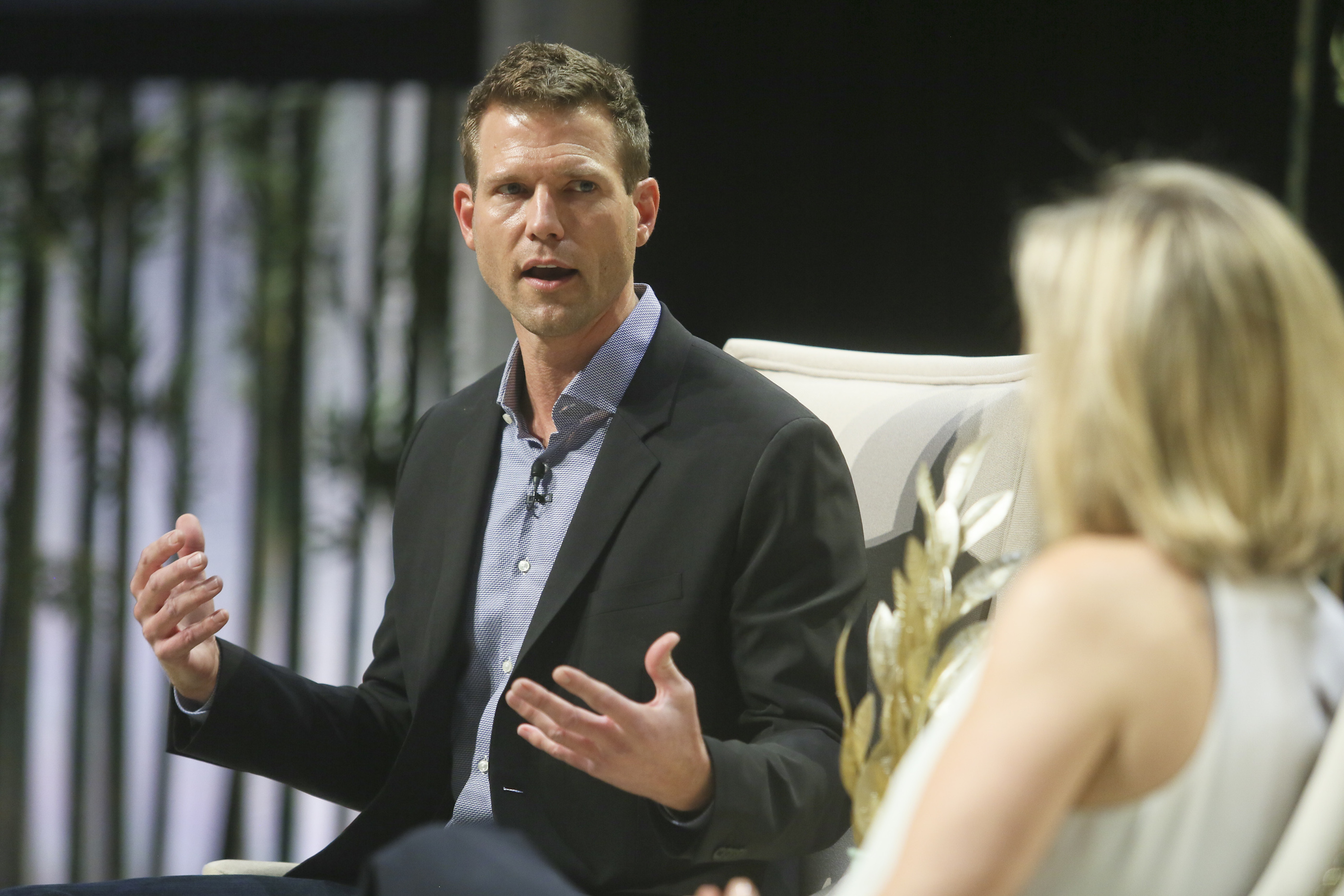
Dr. Travis Stork. Photography by Jack Plunkett.

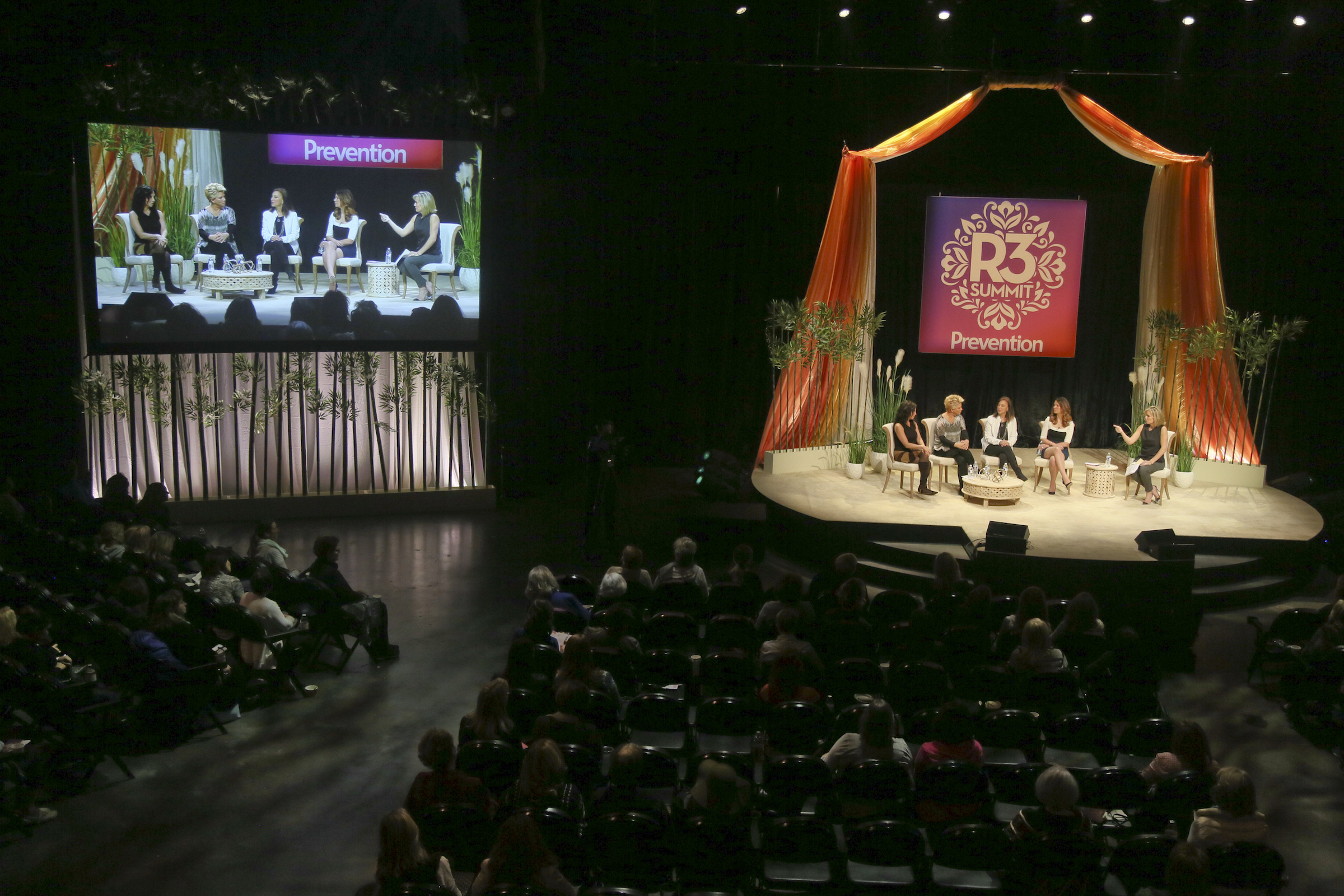
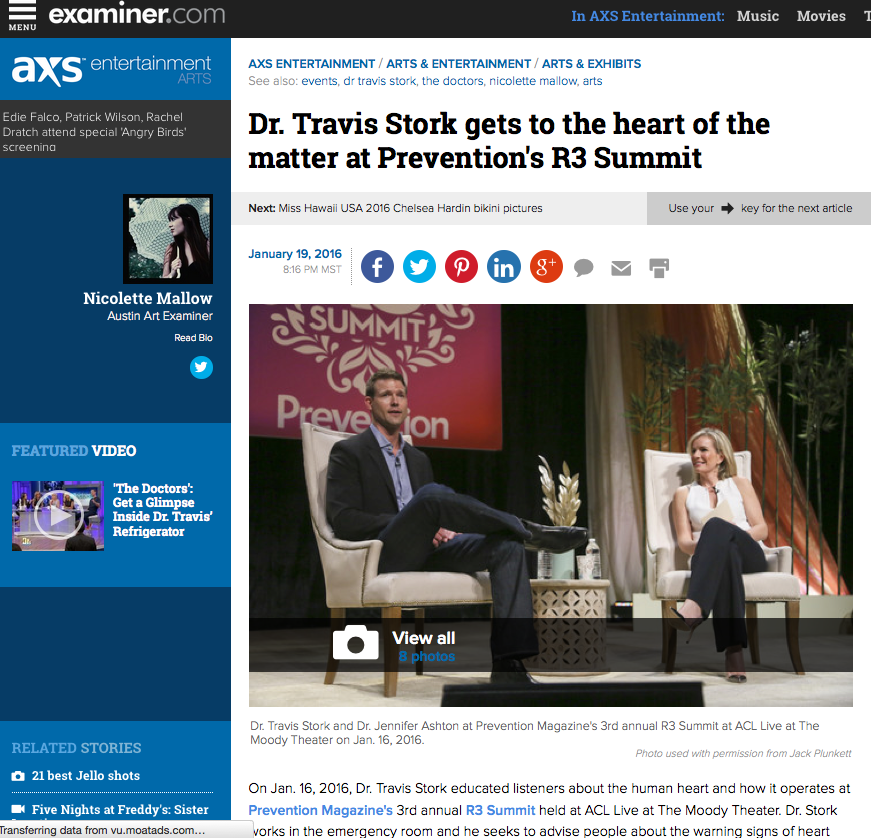
Dr. Travis Stork educated listeners about the human heart and how it operates at Prevention Magazine’s 3rd annual R3 Summit held at ACL Live at The Moody Theater on Jan. 16, 2016. Dr. Stork works in the emergency room and he seeks to advise people about the warning signs of heart malfunction and when to seek immediate medical attention. Joining him on stage was R3’s Master of Ceremonies, Dr. Jennifer Ashton, a Board-certified ob-gyn and fellow co-host of the Emmy®- Award–winning show “The Doctors”, ABC Chief Health Correspondent. Together, the two doctors delivered a compelling, interactive, playful and graphic presentation regarding heart disease and other medical miscellany.
Heart disease is the number one killer for both women and men. And Dr. Travis Stork says that too many people neglect the warning signs or the red flags of heart-related health problems due to factors such as lack of knowledge or lack of awareness. Sadly a lot of people are unaware of the symptoms or they unknowingly confuse a heart attack for something less severe like fatigue, numbness, indigestion or nausea. Resulting in a heart that goes untreated, sometimes until it’s too late. “Time is muscle” and Dr. Stork wants everyone to be aware of the facts.

“Dr. Travis Stork is an Emmy®-nominated host of the award-winning talk show, ‘The Doctors’, and a board-certified emergency medicine physician. He graduated Magna Cum Laude from Duke University as a member of Phi Beta Kappa and earned his M.D. with honors from the University of Virginia, being elected into the prestigious honor society of Alpha Omega Alpha for outstanding academic achievement. Based on his experiences in the ER, Dr. Stork is driven to teach people how to prevent illness before it happens. As a motivational speaker on the topic of health and wellness, Dr. Stork teaches people how to achieve optimal health by focusing on the 200-plus seemingly inconsequential health decisions people make throughout each day.”

Prior to his presentation at Prevention Magazine’s R3 Summit—Nicolette Mallow, an Arts & Entertainment Examiner within Austin—interviewed Dr. Travis Stork in the Press room.

Nicolette Mallow: Working as an ER doctor, obviously you deal with a lot of blood and trauma. You have numerous patients in dire pain and distress, sometimes on the verge of life or death. How do you handle such high volumes of pressure and chaos on a daily basis and remain calm all the while to serve and heal your patients?

Dr. Travis Stork: Being an ER doctor is a lot like anything else. A learned skill. For instance, I am sure when you began writing and interviewing people that it made you nervous. You had doubts, fears and hesitations. Everything can be scary in the beginning. As an ER doctor, I felt all those emotions and fears in the beginning. But as time went by it became more and more of a routine and I overcame my fear. When you have a patient gushing or squirting out massive amounts of blood: you have to learn to overcome the fear, manage the stress and work under pressure.

NM: What is one aspect of being a doctor that Medical school could not prepare you for?

DTS: The healthcare system. It’s a beast. Nothing at school could’ve ever prepared me for that and it’s most definitely a huge problem that I was not prepared for. Fortunately doctors are becoming more vocal about our dysfunctional healthcare system and seek to improve the inadequacies.

NM: A veteran who served our country overseas as a Combat medic in the US Army during times of war once told me that the heart is the most important organ in our body. People often think it’s the brain, but he told me that the brain can die and yet the heart stays awake. Which is what happens when people go into a coma. Do you agree that the heart is our most imperative organ?

DTS: Yes; without a doubt the heart is the most crucial organ. Let’s say someone’s brain is damaged after a heart attack or the brain stops functioning. The result is not because the brain died or was damaged on its own without cause. It doesn’t just happen for no reason. When oxygen flow is cut off from the heart to the brain, tissue dies. The effect of such scar tissue is damage (sometimes permanent damage) to the brain. Our heart pumps out blood and oxygen that flows into every particle, cell and organ within the body.

For those unable to hear Dr. Travis Stork’s live presentation at the R3 Summit, there is plenty of information provided by online. Please refer to his videos “Signs of a Heart Attack” and what happens to the body during a “Heart Attack”.

Note: This article was originally published on Examiner.com in January 2016.

Joan Lunden empowers others by sharing her stories of survival and life purpose

JP1_5354

Joan Lunden. Photo Credit: Jack Plunkett.

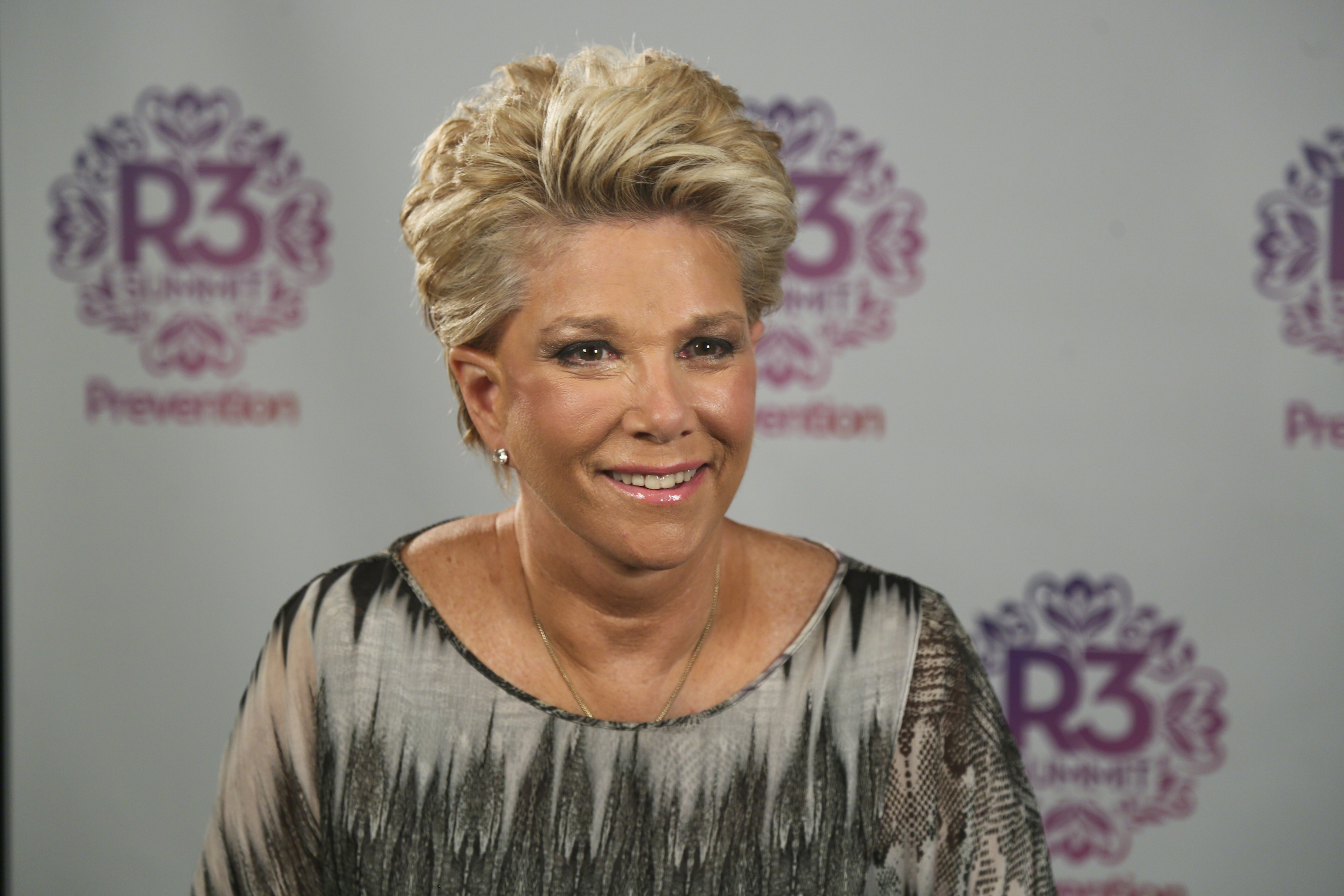
Joan Lunden delivered a vivacious and heartfelt keynote speech for Prevention Magazine’s third annual R3 Summit held at ACL Live at The Moody Theater within the Warehouse District of Austin, Texas on January 16, 2016. As she stood on the main stage under bright lights and gold curtains: Lunden’s words filled the room like fresh oxygen, purifying the air. Her message and its delivery focused on the vitality of self-care and self-love. Why all women need to discover their life purpose and how to follow our dreams. Lunden also emphasized the utmost importance of sustaining a positive attitude whenever life is feeling dark, dreary or defeating. Her message encouraged all women to take care of their health as if it were a second job in order to avoid a collapse or a burn out.

Ultimately, Lunden speaks out to pass on her life story in order to educate and empower all womankind. Joan Lunden speaks out in hopes of seeing the light within every woman shine bigger and brighter than ever before. To see the stars in every woman take flight. And to help other cancer survivors make it through the hardest of times. Many moments throughout the keynote speech, she addressed all the women in the audience as ‘us’ and ‘we’, unifying women of all age, nationality and ethnicity.

A survivor of breast cancer, Joan Lunden is also an award-winning journalist, bestselling author, health & wellness advocate, motivational speaker, successful entrepreneur and mom of seven children. Listening to Lunden’s life stories of survival, television, journalism, family, men, health, sex, life and death—listening to how she succeeded despite any or all challenges or tragedies—was a deeply inspiring message to hear. Prior to Lunden’s keynote, The Master of Ceremonies for R3 Summit, Dr. Jennifer Ashton (a Board-certified Ob-Gyn, author and co-host of the award-winning talk show The Doctors) introduced her colleague to the audience as “The Queen of Good Morning America” and it’s a most befitting, honorary title.

To much delight, after the keynote address Joan Lunden sat down for a brief interview with local A&E Austin Examiner, Nicolette Mallow, to briefly discuss motherhood and her own inner-light.

Nicolette Mallow: Motherhood was a big focus throughout your presentation. And while I do value, honor and respect family traditions. Do you have any advice for women (of any age) that are unable to bear children? Or do you have any words of encouragement for women that choose to not have children in a society where motherhood almost seems to be expected of us?

Joan Lunden: When I first became a mother, I bore three beautiful children the natural way. Later on in time when I wanted to have more children in my 50’s, it was not as easy to get pregnant. I began using fertility methods like in vitro. Eventually it became too complicated. One day my husband lovingly reminded me that it’s not a competition. And I quit in vitro. At that point we sought out a surrogate mother. Our surrogate mother has become like family to us. I now have two sets of twins in addition to my other three kids. And it’s wonderful. I love all seven of my children equally. So, no woman should think just because their body cannot facilitate childbirth that there is anything inadequate with them… On the other hand, I have many female friends that do not have children and are successful and happy individuals. Motherhood does not define a woman even if it can be an all-encompassing trait of what it means to be a woman.

NM: Your career is so impressive and I know you have even more to offer the world in the years to come. However, when was the time in your career that you knew you’d made it?… Your life is so magical on so many levels that it reminds me of Elizabeth Taylor’s line in the Hollywood film based on Tennessee William’s play Suddenly Last Summer. The line when she speaks of ‘the sunshine days’. The days everything was in perfect sync and harmony… When was it that you knew in your heart that it was only going upward in your career from then on?

JL: (she smiled) During my 30’s when I began co-hosting Good Morning America with Charlie Gibson. That was when I knew. He and I used to describe the feeling as “the best seat from which to view the world”. It was an amazing time of my life with such happiness that I will always cherish… Suddenly I was going to The White House, interviewing politicians, rock stars, celebrities and all sorts of prominent figures. I was traveling worldwide covering global news… The happiness we felt on the show is something I will always treasure. Charlie Gibson and I made a strong team and we co-existed together. Which really caught everyone’s attention: seeing a man and woman work together so wonderfully on national television. Having said this, I am sort of a Master of Reinvention, and so I look forward to new journeys and new thrills as I began new media campaigns.

For more information pertaining to Joan Lunden’s life story of survival and success. Or to find health, beauty and lifestyle tips, please visit her website Joan Lunden: Creating a healthy lifestyle for a better tomorrow at www.joanlunden.com.

Note: This article was originally published on Examiner.com in January 2016.

Bob Roth talks Transcendental Meditation and dharma at Prevention’s R3 Summit

nicolette mallow

Bob Roth. Photo Credit: Jack Plunkett.

Transcendental Meditation teacher Bob Roth spoke on the opening night of Prevention Magazine’s R3 Summit at ACL Live at The Moody Theater in Austin, Texas on January 15, 2016. Self-transcending meditation was the focus of his speech. Bob Roth explained how this unique and timeless form of meditation could transform people’s lives for the better. Living in a such a stressful world where everything around us is moving at a hurried and constant pace, it can be immensely difficult, if not beyond overwhelming, for us to take complete care of ourselves: body, mind and soul. Through the course of his interactive presentation, Roth guided listeners through the scientific process as to how transcendental meditation and its sound mantra practice can help strengthen the brain and relieve trauma, stress or stagnant energy that’s locked in our minds. This form of meditation even lowers high blood pressure, reduces chronic pain and depletes excess amounts of Cortisol levels, a hormone that is directly related to stress. He described the end result like being in a state of dharma.

  • nicolette mallow

Sharing stories of healing and delivering an insightful overview of his life’s work. A career that began in 1968 around the age of 18, when Bob Roth started to change his diet and even studied Prevention Magazine. Roth emphasized and explained the immense empowerment and peace-of-mind that comes from transcendental meditation (TM). He expressed the ‘constellation of positive changes’ and scientifically described the peacefulness that comes from integrating TM® into the routine of our daily lives.

“Bob Roth is one of the most experienced and sought-after meditation teachers in America. Over the past 40 years, Bob has taught Transcendental Meditation to many thousands of people and authored an authoritative book on the subject, fittingly entitled, Transcendental Meditation, which has been translated into 20 languages. Bob currently serves as the Executive Director of The David Lynch Foundation, a 501(c)(3) charity which has brought meditation to over 500,000 inner-city youth in underserved schools in 35 countries, to veterans and their families who suffer from post-traumatic stress, and women and children who are survivors of domestic violence.”

Fortunately, Mr. Roth also had a moment to speak with an A&E Austin Examiner, Nicolette Mallow, regarding this ancient form of meditation.

Nicolette Mallow: During your presentation, you mentioned that you’re deeply focused on helping children, homeless shelters and veterans suffering post-traumatic stress disorder (PTSD). And I do believe that people find immense peace and calm through transcendental meditation. The end results are obviously beneficial and worthwhile. But it can be hard for those who’ve endured such trauma to sit still in the silence and close their eyes. How do those beginning TM® overcome the struggle to find the patience and stillness to meditate with such internal angst? How do people overcome their turmoil and meditate in peace?

Bob Roth: That’s a beautiful question… Transcendental meditation doesn’t enter darkness and it’s a very forgiving practice that is practically effortless. Closing our eyes and looking into the dark can be scary. TM® is not scary nor is it a grueling process that sets off triggers or trauma. It’s a very charming, peaceful form of meditation. It does not evoke darkness on any level, and it feels like being in a state of dharma. Therefore people want to repeat it because it brings out positive feelings: a complete state of peacefulness.

NM: Does it take a lot of time to learn and is it hard to integrate into daily routine?

BR: It does not take much time to learn and it’s an easily acquired skill. This is why we have TM® teachers to help others begin the sound mantra meditations over the course of four days so it’s imprinted into memory… Frankly no one has the time. But what’s the alternative? Stress destroys life and it’s toxic. If we make the time twice a day to meditate, the results are remarkable and deliver an inner-calmness, ease, peace and state of happiness. Every aspect of our health and mental wellness improves after meditation. Transcendental meditation protects and regenerates the body. It’s very cleansing and the feeling of awakening and resilience is very purifying.

For more information regarding Transcendental Meditation and where to locate a TM® teacher in your area: please visit their website at http://www.tm.org. Lastly, if you are a veteran or know a loved one that served and is in need of cost-free healing: The David Lynch Foundation also has a division, Operation Warrior Wellness (OWW), that serves veterans in need of healing. Donations to sponsor a veteran can also be submitted on their website.

Note: This article was originally published on Examiner.com in January 2016.

nicolette mallow


Elvis Costello’s memoir: Unfaithful Music & Disappearing Ink

nicolette mallow

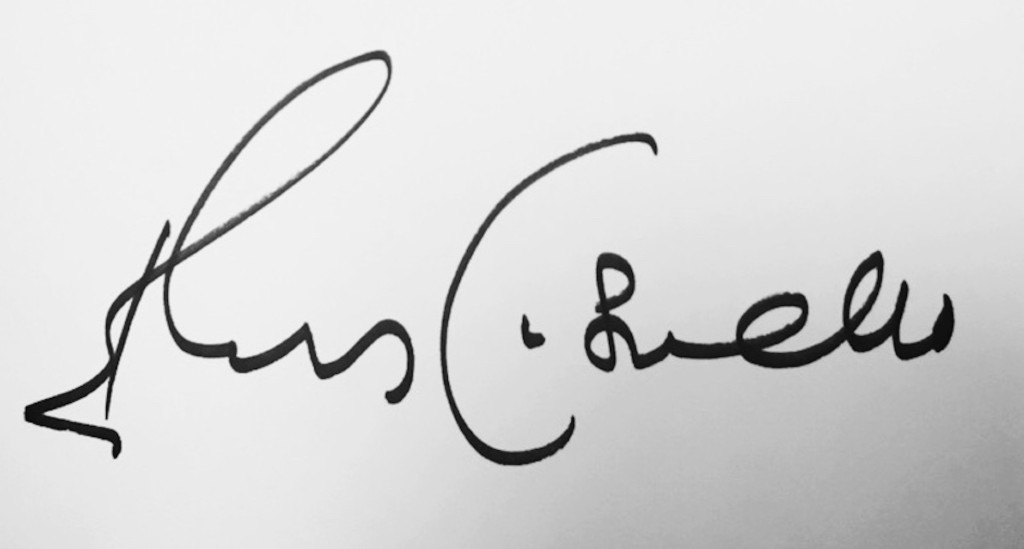
Autograph by Elvis Costello.

Elvis Costello was the featured guest for an interview with Evan Smith at Book People in Austin, Texas on October 20, 2015. Recently, Costello wrote a memoir titled Unfaithful Music & Disappearing Ink. This exclusive interview was part of his book tour. Entering the room with a light-colored hat, dark suit and vest, black-framed glasses, one gold ring on each hand and slick, black leather shoes: Elvis Costello descended the stairwell from the third floor to discuss the book and his life lived in music thus far. The entire second floor of Book People was filled with attendees and so many people were present that quite a few were listening in the back without a view of Elvis Costello; only able to hear voices echoing over the microphones. Fortunately I was able to grab a front row seat and sit on the floor.

Music is clearly the anthem of his life and the focus of his career. He’s been part of the industry over 40 years. The book is a collection of memoirs entailing his entire life, with a emphasis on his career. During the interview Elvis Costello answered numerous questions and mentioned various musical stories regarding Paul McCartney, The Beatles, T Bone Burnett, Tony Byrne, Jimmie Vaughan, and Jimi Hendrix. Reluctantly, he even rehashed the old SNL incident back in December 1977 that got him banned from the show for nearly 12 years. Additionally, he spoke of his favorite gigs played in Austin and the time they performed at the Armadillo Festival in 1978.

This slideshow requires JavaScript.

To much delight, Costello was also very open and willing to share the more personal stories of his past about family, his love and lust for women, or the curse of memory. Costello mentioned that memory, and the fear of losing memory, were two strong factors that compelled him to write the book. He discussed the long process of writing his autobiography and how the process was simplified with the patient support of his wife through her assistance to help organize old memories. Many of his relatives, he said, suffered dementia and Costello didn’t want any memories stolen away in the event that time or health altered his mind. Unafraid to go behind-the-scenes and express life offstage, it was interesting to listen to him speak about how he’s changed over several decades from when he began his musical career as a young man in his 20’s until now in his 60’s. “I wanted my stories to be told by me, in accuracy. I didn’t want them retold in a way that didn’t hold true to my life,” he stated to Evan Smith.

In regards to Elvis Costello’s past, the topic of family and his memories of childhood were predominant, reoccurring themes throughout the interview. Many old photographs of times past were presented on a large screen, even a heartfelt video of his father performing live on television and dancing on stage whilst singing “If I Had A Hammer”. Elvis Costellospoke fondly about both his parents and there was great love and adoration in his voice when he shared old memories and his love for family. Nonetheless, there was a huge emphasis on his father, Ross McManus, a well-known musician and trumpet player. In fact, Costello made a point to inform the audience that October 20th, that very day, was indeed his father’s birthday. A particularly poignant memory of childhood included Costello telling the audience how he peeked around the back of the TV as a small boy to see if he might find his father behind the machine, only to realize that his dad was on stage in a studio. I found those sorts of memories to be the most endearing because only a child could think someone or something could transform into a miniature size and fit inside a TV. Costello’s honesty and his ability to tell old memories as if he were reliving it that very moment humanized his life story and made the interview all the more refreshing to hear.

Growing up in a house of music, all my life I’d heard the name ‘Elvis Costello’ and I knew he was a musician, singer-songwriter and record producer from England. I knew he’d been inducted into the Rock and Roll Hall of Fame and I knew he’d been to Austin many times to perform. The city of Austin has always loved hosting Elvis Costello shows and over the past 20 years: I’d seen his name printed all over line-ups in the press. But to be quite frank, I really had no idea how in-depth his career was or how influential he was until this interview and until I began reading his memoir. Not only did I walk away that night learning and absorbing new insights about a famous musician born in Europe. That evening I became an Elvis Costello enthusiast. Just listening to the stories during the interview had me intrigued, eager to finish the rest of his book I’d only obtained one day prior to the event. However, the moment when he surprised us with live music and began to play “Everyday I Write the Book” and I heard those lyrics for the first time only a few feet away from Elvis Costello in the flesh and blood: I felt a strong connection to the music. I wanted to hear more. My heart was so deeply moved by the words in his lyrics that it almost made me want to cry, in a good way. Since then I’ve started to read many of his lyrics and it’s clear to me now why he’s become a global success for 40 years. Elvis Costello is an artist whom posses a distinct voice and an edge. An artist that followed his heart and writes from the heart. A one-of-a-kind artist with innate gifts of articulation, imagination and passion. Gifts that cannot be taught nor bought.

Furthermore, Costello read a few chapters from his newly released memoir, Unfaithful Music & Disappearing Ink. Ending the evening on a high note, that’s when he played a bit of live music for the audience. We even got a little history lesson about his guitar in-between songs. A short video of his performance that I recorded from my seat can be found here on YouTube: Elvis Costello playing music at Book People.

Elvis Costello’s memoir was released in October 2015. The nearly 700 page story hasn’t been on the bookshelves that long but it’s already receiving quite a bit of positive feedback and attention from the media. Posted verbatim on his official website, “Born Declan Patrick MacManus, Elvis Costello was raised in London and Liverpool, grandson of a trumpet player on the White Star Line and son of a jazz musician who became a successful radio dance-band vocalist. Costello went into the family business and before he was twenty-four took the popular music world by storm. Costello continues to add to one of the most intriguing and extensive songbooks of our day. His performances have taken him from strumming a cardboard guitar in his parents’ front room to fronting a rock and roll band on our television screens and performing in the world’s greatest concert halls in a wild variety of company. Unfaithful Music & Disappearing Ink describes how Costello’s career has endured for almost four decades through a combination of dumb luck and animal cunning, even managing the occasional absurd episode of pop stardom. This memoir, written entirely by Costello, offers his unique view of his unlikely and sometimes comical rise to international success, with diversions through the previously undocumented emotional foundations of some of his best-known songs and the hits of tomorrow. It features many stories and observations about his renowned cowriters and co-conspirators, though Costello also pauses along the way for considerations of the less appealing side of fame.”

Unfaithful Music & Disappearing Ink can be purchased online or at your local bookstore. For more information regarding Elvis Costello, his book tour, list of albums or other miscellany: please visit the website at www.elviscostello.com.

“Don’t tell me you don’t know what love is. When you’re old enough to know better. When you find strange hands in your sweater. When your dreamboat turns out to be a footnote. I’m a man with a mission in two or three editions. And I’m giving you a longing look. Everyday, everyday, everyday I write the book. Chapter One we didn’t really get along. Chapter Two I think I fell in love with you. You said you’d stand by me in the middle of Chapter Three. But you were up to your old tricks in Chapters Four, Five and Six. The way you walk. The way you talk, and try to kiss me, and laugh. In four or five paragraphs. All your compliments and your cutting remarks. Are captured here in my quotation marks. Don’t tell me you don’t know the difference. Between a lover and a fighter. With my pen and my electric typewriter. Even in a perfect world where everyone was equal. I’d still own the film rights and be working on the sequel… Everyday I write the book.” – Elvis Costello

Note: This story is originally published on Rank & Revue in July 2015.

logo1